
Buying out of state is worth it when the savings on price or selection beat the added cost of taxes, transport, and paperwork, usually a difference of several hundred to a few thousand dollars, depending on distance. Before anything else, pull a vehicle history report and confirm the title is clean and lien-free. Do that before you send a deposit or book a flight, not after.
TL;DR:
- Comparing out-of-state prices can save several hundred to a few thousand dollars, but only if the total costs of taxes, transport, and paperwork are lower.
- Confirm the vehicle's history, title, and lien status before sending any deposit or booking travel, and consider a local mechanic inspection if possible.
- Sales tax is paid where you register the vehicle, with some states offering partial exemptions for nonresidents if paperwork conditions are met.
- Driving the car home is typically cheaper for short distances, but shipping may be necessary for longer routes or in cases with tight schedules.
- Using a trusted dealer for out-of-state purchases simplifies paperwork, inspections, and title transfers, especially for high-value or luxury vehicles.
Table of Contents
- What Are the Steps for Out-of-State Car Buying?
- How Do Sales Tax and Registration Work Across State Lines?
- How Do You Verify a Car's History and Condition Remotely?
- Should You Drive the Car Home or Ship It?
- What Does the Full Cost and Timeline Actually Look Like?
- Why a Trusted Local Dealer Changes the Math on Remote Buying
- How Autovendorsfl Simplifies Buying a Car From Out of State
- Sources
What Are the Steps for Out-of-State Car Buying?
Out-of-state car buying follows a predictable sequence, and skipping a step is usually what turns a good deal into a headache. Here's the order that actually protects you.
- Research the listing and the incentives. Compare pricing across Kelley Blue Book, Edmunds, and JD Power before you fall in love with a listing. Manufacturer rebates are often tied to ZIP code, so check incentives using both your home ZIP and the seller's ZIP. A car that looks like a steal in Texas can lose its advantage once you factor in a Massachusetts-only rebate you won't qualify for.
- Pull the vehicle history and check the title. A vehicle history report from CARFAX or AutoCheck verifies mileage, accident history, and open recalls, according to the Federal Trade Commission. Confirm the title is not salvage or rebuilt, and ask the seller directly whether there's a lien. Get this documentation before any money changes hands, not after you've wired a deposit.
- Arrange a pre-purchase inspection. If you can't see the car in person, hire a local independent mechanic near the seller to do a physical inspection, such as those offered by Kwik Kar Lube & Tune Of Midlothian. This is, according to Edmunds, the most reliable way to confirm a car's real condition when you're buying sight-unseen. Ask for dated photos and video of the undercarriage, engine bay, and interior wear as a backup.
- Negotiate and paper the deal properly. Once the inspection checks out, negotiate price and payment terms in writing. You'll need a signed title, a bill of sale, and an odometer disclosure statement, and some states require notarization on one or more of these documents.
- Decide how the car gets home. Driving with a temporary tag is usually cheapest if the distance is reasonable. Shipping makes more sense for long distances, tight schedules, or when you can't take time off to drive.
- Close out the paperwork loop. Confirm your insurance is active, get your temporary tag in hand, and keep the bill of sale and title documents together for your home-state DMV visit.
Before you leave the seller's driveway, run through this quick verification list:
- Proof of insurance covering the new vehicle
- Temporary tag or trip permit displayed and valid
- Signed title with no open liens
- Bill of sale with VIN, price, and both parties' signatures
- Odometer disclosure statement matching the dashboard reading
Pro Tip: Text yourself photos of every signed document the moment ink hits paper. Sellers occasionally "lose" copies, and a phone photo with a timestamp has saved more than one buyer from a title dispute weeks later.
How Do Sales Tax and Registration Work Across State Lines?
Sales tax on an out-of-state purchase is generally paid to the state where you'll register the vehicle, not the state where you bought it. Dealers licensed to sell in that state often collect it at the point of sale; private-sale buyers typically pay it directly at their home DMV when they title the car.
Florida offers a useful illustration of how these rules get technical fast. The state applies a partial sales-tax exemption for nonresidents: the dealer collects tax at the buyer's home-state rate, capped at 6%, instead of Florida's own rate. Claiming that exemption requires a notarized statement declaring you'll register the car in your home state within 45 days. Miss that window or skip the notarization, and you could end up paying Florida's full rate with no easy way to recover the difference.
A few things worth knowing about the paperwork itself:
- Temporary tags or trip permits are usually issued by the seller's state and let you legally drive the car home; validity windows commonly run 10 to 30 days depending on the state.
- Most home states give you a set number of days to register a newly purchased out-of-state vehicle before penalties apply.
- You may need an emissions test or VIN verification at registration, especially in states with strict standards.
- Dealerships licensed in the seller's state typically handle these details directly, issuing temporary tags and title reassignment forms as part of the sale, which is one reason working with an established dealer for an out-of-state purchase across state lines removes a layer of guesswork private sellers can't offer.
Buying out of state remains completely legal and common. You will still owe registration and taxes in your home state, and you may need emissions or VIN verification to get plates. Confirm your state's rules on our dealer-handled title transfer guide before you assume the seller's state paperwork covers everything.
How Do You Verify a Car's History and Condition Remotely?
A history report tells you what happened to the car; an inspection tells you what shape it's in now. Both matter, and neither substitutes for the other.
When you pull the CARFAX or AutoCheck report, watch for these red flags:
- Salvage or rebuilt title branding
- Mileage inconsistencies between service records and the odometer
- Open manufacturer recalls with no repair on file
- Multiple owners in a short window, which often signals an unresolved issue
Lien status deserves separate attention. Electronic titles in many states don't show the lien visually the way a paper title does, so ask the seller for written lien-release confirmation from their lender if the car was financed. If a lien shows up mid-transaction, the sale should pause until the seller's bank confirms payoff.
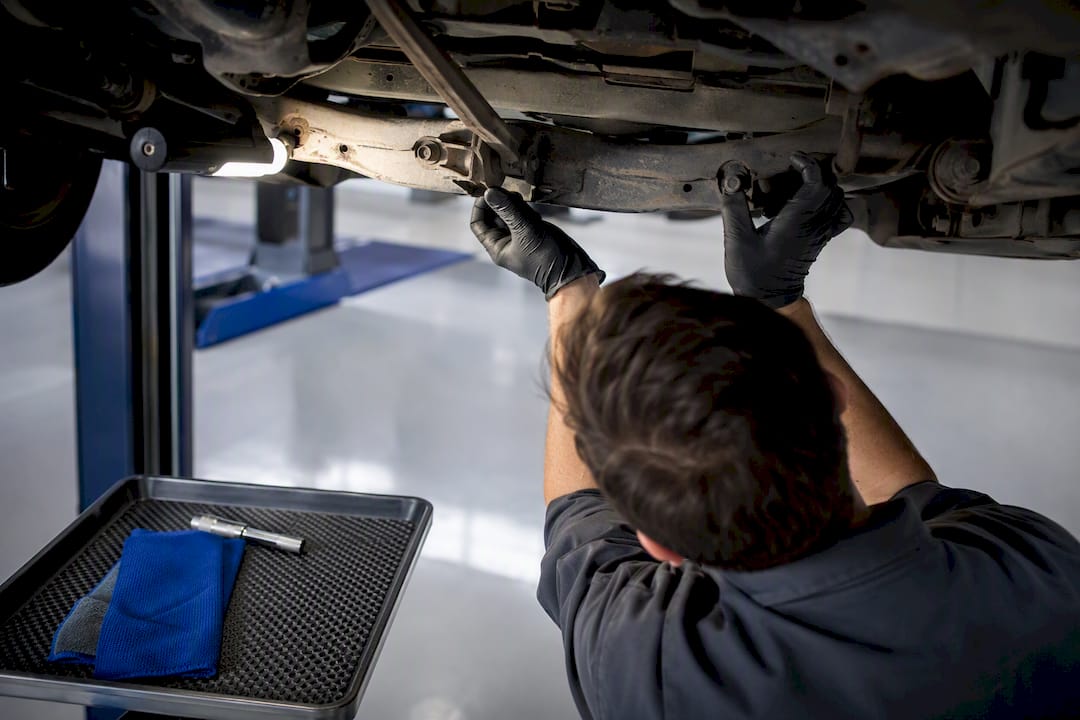
For the physical inspection, a thorough pre-purchase inspection (PPI) typically runs in the low hundreds of dollars, a small price against the cost of a hidden transmission problem. Have the mechanic check the engine, transmission, frame, fluid condition, and emissions labeling, and run a full test drive. For luxury and performance vehicles, our pre-owned luxury inspection checklist covers the brand-specific items a general mechanic might miss.
Pro Tip: If the inspection turns up a fixable issue, use the repair estimate as a negotiating tool rather than walking away outright. Sellers are often more willing to knock a few hundred dollars off than to fix it themselves.
Should You Drive the Car Home or Ship It?
Driving with a temporary tag is almost always the cheaper option for reasonable distances, once you factor in fuel, lodging, and your time. Beyond that, shipping starts to look more attractive, though it comes with a real cost tradeoff. Enclosed transport in particular can run into the thousands of dollars, which can erase much of the savings that made the out-of-state deal appealing in the first place.
Insurance is the piece buyers forget until it's too late. Most insurers offer a grace period, commonly 7 to 30 days, for adding a newly purchased vehicle to an existing policy, but "commonly" isn't "guaranteed."
- Call your insurer before you travel and get written confirmation of your specific grace period.
- Carry proof of insurance, the bill of sale, and your temporary tag any time you're driving the car across state lines.
- If shipping, vet the carrier's insurance coverage and get a written estimate covering pickup and delivery windows.
If a vehicle wrap, tint, or aftermarket accessory is part of the deal, confirm it's actually covered under your policy rather than assuming standard coverage extends to it.
What Does the Full Cost and Timeline Actually Look Like?
The sticker price is rarely the real price once you add every line item. Before comparing two out-of-state offers against a local one, build a simple total for each:
- Vehicle purchase price
- Sales or use tax owed at registration
- Travel or shipping cost to bring the car home
- Pre-purchase inspection fee
- Temporary tag or trip permit cost
- Any emissions or safety fixes flagged during the inspection
Add those six numbers for each option, then compare the totals side by side rather than comparing sticker prices alone. A car priced $2,000 below local market can still lose if shipping runs $1,200 and repairs add another $900.
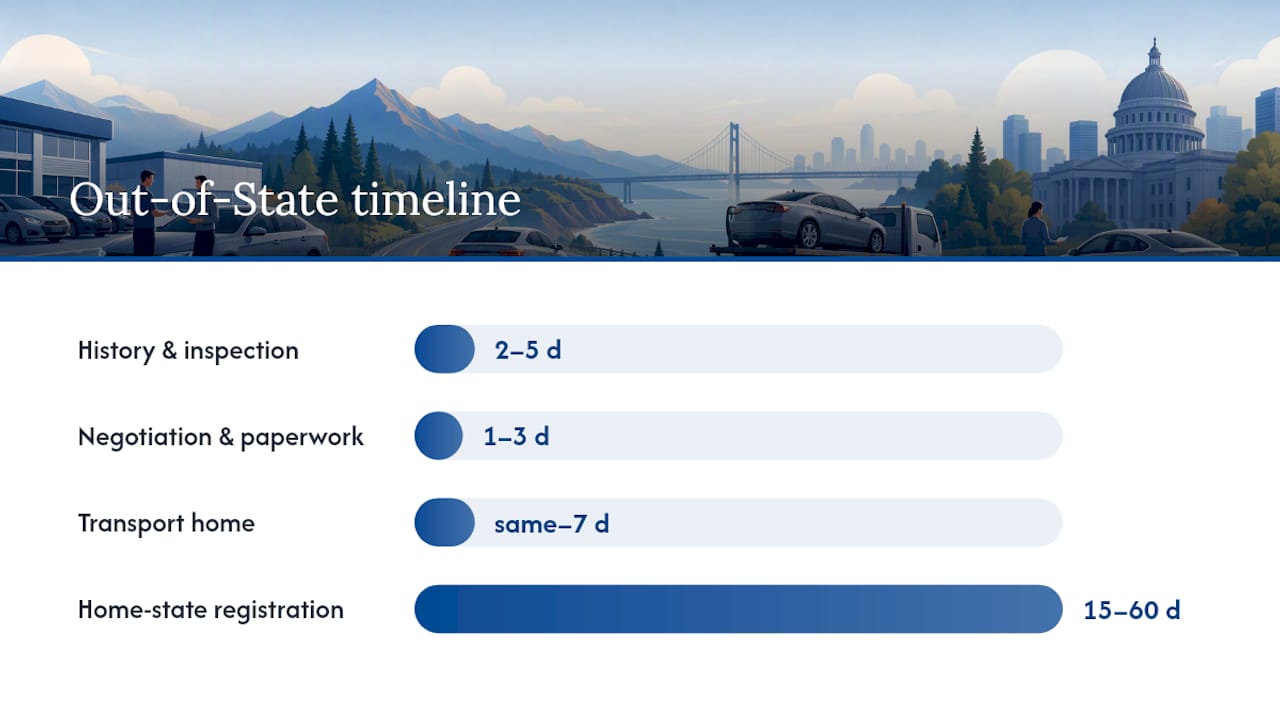
On timing, expect roughly this sequence: history report and inspection (2 to 5 days), negotiation and paperwork (1 to 3 days), transport home (same day to a week, depending on distance), and home-state registration (within your state's deadline window, often 15 to 60 days from purchase). Miss that last deadline and you're often looking at late fees on top of everything else.
Why a Trusted Local Dealer Changes the Math on Remote Buying
Paying a dealer's fee makes sense once you're buying sight-unseen or spending real money on a luxury vehicle. A dealership can coordinate a brand-specialist inspection, handle temporary tag issuance, and manage title reassignment in ways a private seller simply can't offer. That combination cuts paperwork risk dramatically on high-value purchases, which is exactly where mistakes get expensive. Our remote purchase guide walks through what that coordination looks like in practice.
— Allen
How Autovendorsfl Simplifies Buying a Car From Out of State
Out-of-state deals can carry guesswork and risk. Instead of chasing a seller's paperwork or relying on inspection photos alone, consider getting personalized vehicle finding, coordinated pre-purchase inspections, and hands-on handling of temporary tags, title transfer, and tax collection through an experienced dealer.
If a luxury sedan is on your list, browse the Mercedes-Benz inventory or check current Audi A4 listings to see what's available now. For readers weighing a more practical daily driver, the Ford Focus inventory is worth a look too. Reach out to a trusted dealer for a remote-buy consultation to help manage the paperwork and reduce the risks of your next out-of-state purchase.
Sources
- FTC — Used cars: 5 tips to avoid a lemon
- Edmunds — Buying a car sight-unseen
- LegalClarity — How to buy a car in Florida from out of state