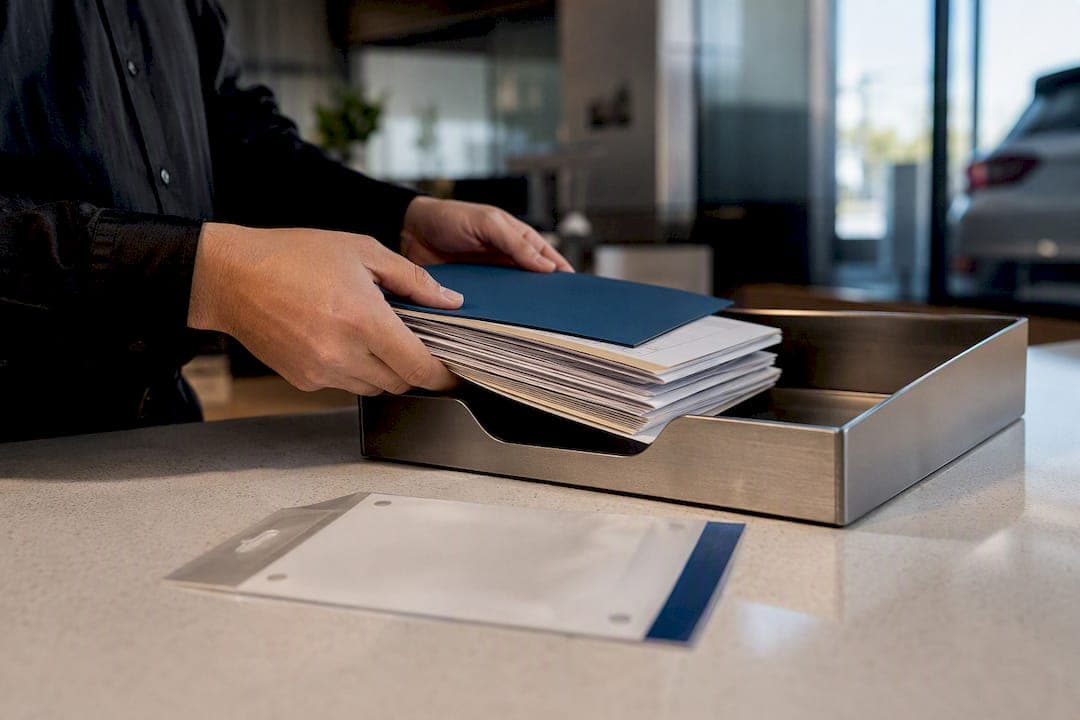
Most U.S. dealerships file title and registration paperwork on the buyer's behalf, and they can typically issue a temporary tag while the state processes your paperwork. That said, "most" isn't "all." Before you sign anything, confirm in writing whether the dealer will file the title, who covers state fees, and when your temporary registration expires. If the dealer won't handle it, you'll need to file the application with your state's DMV yourself.
TL;DR:
- Most dealerships file the title and registration paperwork for buyers, but confirm in writing who handles fees, filing, and expiration dates before signing.
- Buyers must provide key documents such as the signed title, bill of sale, odometer disclosure, proof of insurance, and lien information to complete the transfer smoothly.
- State fees like title transfer, registration, and sales tax are separate from dealer charges, which are often negotiable and should be itemized in the quote.
- Temporary registration typically lasts 30 to 90 days, but delays in processing, high DMV volume, or lien issues can extend waiting periods beyond initial expectations.
- If the dealer does not file the transfer, buyers should gather all required documents and submit an application directly to the DMV, keeping proof of submission for reference.
Table of Contents
- What Dealerships Typically Do During a Title Transfer
- Documents Checklist: What Buyers and Sellers Must Provide
- Fees and Taxes: What Is a State Charge and What Is a Dealer Charge
- Timeline and Deadlines: How Long Transfers Typically Take
- Out-of-State Purchases, Electronic Titles, and Lienholder Complications
- If the Dealer Doesn't Complete the Transfer: Filing at the DMV Yourself
- Dealer Negotiation Checklist and Red Flags
- Why Dealers Handle Title Work, and What Buyers Should Expect
- Let Autovendorsfl Handle Your Title Transfer Paperwork
- Authoritative DMV and Consumer Resources
- Sources
What Dealerships Typically Do During a Title Transfer
A licensed dealer usually acts as your go-between with the state motor vehicle agency. That means submitting the title application, collecting the taxes and fees the state requires, and issuing a temporary registration or tag so you can legally drive off the lot while the permanent title works its way through processing.
California DMV guidance confirms dealers can issue temporary registration and typically handle the paperwork, but the buyer still has to supply the certificate of origin or signed title, an odometer disclosure when the vehicle qualifies, and payment for use tax and registration fees. In Maryland, most licensed dealers submit title paperwork for the buyer, and the state's MVA mails the Certificate of Title once it clears processing.
Here's what actually happens behind the counter at most stores:
- The dealer submits your title application and lien release paperwork to the state, often within a few business days of the sale.
- You get a temporary tag or permit that's valid until the state issues your plates or permanent registration.
- The dealer collects sales tax, title fees, and registration fees on the state's behalf and remits them directly.
- The dealer's own documentation fee, sometimes called a "doc fee," is separate. That one stays with the dealership.
Don't take a verbal promise at face value. Check your buyer's order or purchase contract for a line confirming the dealer will file your title and registration, and ask for a projected date. If that language isn't there, ask the finance manager to add it before you sign.
Documents Checklist: What Buyers and Sellers Must Provide
Every title transfer runs on paperwork, and missing a single form is the most common reason a transfer stalls. Here's the practical list to bring to the table or have ready before you drive off:
- The signed title or manufacturer's certificate of origin. For a used vehicle, this is the current title signed over by the seller. For a new vehicle, the dealer holds the certificate of origin and processes it on your behalf.
- A bill of sale. This documents the purchase price, date, and parties involved, and some states require it alongside the title application.
- Odometer disclosure statement. Federal law requires this on most vehicles under 20 years old at the time of transfer, and the dealer typically builds it into your paperwork stack.
- Proof of identity, usually a driver's license or state ID matching the name going on the new title.
- Proof of insurance, required in nearly every state before registration can be finalized.
- Lien payoff or lienholder information, if you're financing or if the vehicle you're trading in still has an active loan.
- State-specific title application forms, such as California's REG 343 or REG 227, which the dealer usually completes and submits for you.
If the title is lost, the seller (or dealer, in a trade-in situation) needs to request a duplicate title from their state before the sale can close cleanly. A checklist built for documenting rare or complex vehicle acquisitions walks through exactly what to gather when paperwork gets more complicated than a standard used-car sale.
Fees and Taxes: What Is a State Charge and What Is a Dealer Charge
The single biggest source of confusion at closing is figuring out which numbers on your paperwork go to the government and which ones go to the dealership. They're not the same thing, and conflating them is how buyers end up feeling overcharged.
State-level charges include:
- Title transfer fee — a flat fee the state charges to issue a new title in your name. Michigan, for example, charges $15 for this.
- Registration or plate fee — typically $10 to $15 in Michigan, though every state sets its own amount.
- Sales or use tax — calculated as a percentage of the purchase price. Michigan applies a 6% sales tax; California calculates use tax based on your local rate [Michigan Secretary of State; California DMV].
The documentation fee is different. It's dealer revenue, not a state fee, and in most states there's no cap on what a dealer can charge. Some dealers use it to cover paperwork labor. Others treat it as built-in profit, which is why an out-the-door price matters more than any single line item.
Pro Tip: Ask for an itemized quote before you sign anything, and negotiate the total out-the-door number rather than fighting the doc fee line by line. Dealers rarely lower a doc fee directly, but they'll often adjust the vehicle price to compensate.
Red flags worth walking away from: a doc fee with no explanation, a verbal "it's just how we do it here," or any refusal to show you a written fee breakdown before you commit.
Timeline and Deadlines: How Long Transfers Typically Take
States set hard deadlines for completing a title transfer, and missing them costs money. Michigan charges a $15 late fee if the transfer isn't completed within 15 days. California generally expects transfers reported within 10 days, and penalties apply beyond that window [California DMV].
Your temporary registration bridges that gap, but it has limits worth knowing:
- It's typically valid for a set number of days, often 30 to 90 depending on the state, and it does not extend automatically.
- It covers you to legally drive and get pulled over without a ticket, but it does not substitute for your permanent title.
- If your permanent plates or title haven't arrived by the time the temp tag expires, contact the dealer immediately rather than waiting it out.
Processing delays happen for ordinary reasons: high DMV volume, a lien that hasn't cleared, or a paperwork error that bounces the application back. If more than three or four weeks pass with no update, call the dealer's finance office and ask for your application's tracking or confirmation number. You're entitled to that information.
Out-of-State Purchases, Electronic Titles, and Lienholder Complications
Buying from a dealer in another state changes the math. Many out-of-state dealers will not file your title with your home state's DMV, which means you may need to complete that step yourself once the vehicle arrives. A guide to remote vehicle purchases covers what to expect when a dealer mails your paperwork instead of filing it locally.
Electronic titles, or eTitles, add another wrinkle. When a vehicle still carries an active loan, the lienholder controls the paper title until the loan is satisfied, which can delay issuance of your new title for weeks.
To resolve a lien-related holdup:
- Request a lien payoff letter from the lender showing the exact amount and date needed to clear the debt.
- Confirm the lienholder has submitted an official lien release to the state, not just to the dealer.
- If you're trading in a vehicle with a loan still attached, get a 10-day payoff quote before finalizing your new purchase so the numbers reconcile cleanly.
If the Dealer Doesn't Complete the Transfer: Filing at the DMV Yourself
Sometimes the dealer simply doesn't file, whether from an out-of-state sale, a backlog, or an oversight. Here's how to handle it without losing your temporary tag window:
- Gather your documents: signed title, bill of sale, odometer disclosure, proof of insurance, and any lien release paperwork.
- Complete your state's title application form, available on your state DMV's website or in person.
- Pay the required title fee, registration fee, and any outstanding sales or use tax directly to the state.
- Submit in person, by mail, or online, depending on what your state allows. In-person visits typically process fastest.
- Keep proof of submission: a receipt, a tracking number, or a confirmation email. This protects you if the application gets delayed or lost.
- If you're the seller, file a release of liability with your state once the sale closes, so you're not on record as the owner if something happens to the vehicle later.
If your title comes back with an error, most states let you request a correction using a simplified form rather than starting the whole application over.
Dealer Negotiation Checklist and Red Flags
Before you sign, ask the finance office three direct questions: Will you file my title and registration? What's the total fee breakdown, itemized? When should I expect my permanent plates or title to arrive?
Watch for vague "out-the-door" quotes that don't break down tax, title, registration, and doc fees separately. That's the most common way costs get buried. A dealer unwilling to put fee estimates in writing, or one that promises a fast title turnaround with nothing documented, is asking you to take it on faith.
Pro Tip: Request the itemized out-the-door quote before you negotiate price. It's far easier to spot an inflated doc fee, or negotiate the total, when every number is visible on paper.
Why Dealers Handle Title Work, and What Buyers Should Expect
Dealerships handle title paperwork because it's part of the transaction they're licensed to close, not a courtesy. Most track document flow through their finance office, from the moment you sign to the day your title lands in the mail. Some dealers confirm with you at signing exactly who files what, and give you a realistic timeline instead of a vague promise. If a dealer can't answer that clearly, that tells you something about how the rest of the sale will go.
— Allen
Let Autovendorsfl Handle Your Title Transfer Paperwork
Certain dealers handle paperwork filing, issue temporary tags on delivery, and track titles through to mailing so you're not left calling around for updates.
Some dealers confirm details in writing at signing, including who covers which fee and when to expect your permanent plates. If you're coordinating a longer-distance move alongside your purchase, Butler Moving's guide to relocating from Tampa is worth a look for handling both logistics at once. Ready to see what's available? Browse our current inventory and ask our team directly about title handling before you commit to a vehicle.
Authoritative DMV and Consumer Resources
For state-specific rules, always check your own state's DMV directly rather than relying on secondhand summaries. California's DMV publishes forms, use tax calculators, and dealer-purchase guidance. Michigan's Secretary of State lists exact fees and its 15-day deadline. Maryland's MVA explains dealer-submitted title paperwork step by step.
On the consumer side, Capital One's breakdown of dealer documentation fees and Car Real Talk's explainer on doc fees are useful reads before you negotiate.
Sources
- Registration for a Vehicle Purchased from a Dealer - California DMV
- Michigan
- Titling a Vehicle Bought From a Dealership - Maryland MVA
- Understanding dealer documentation fees — Capital One
- What Is a Dealer Doc Fee? — Car Real Talk