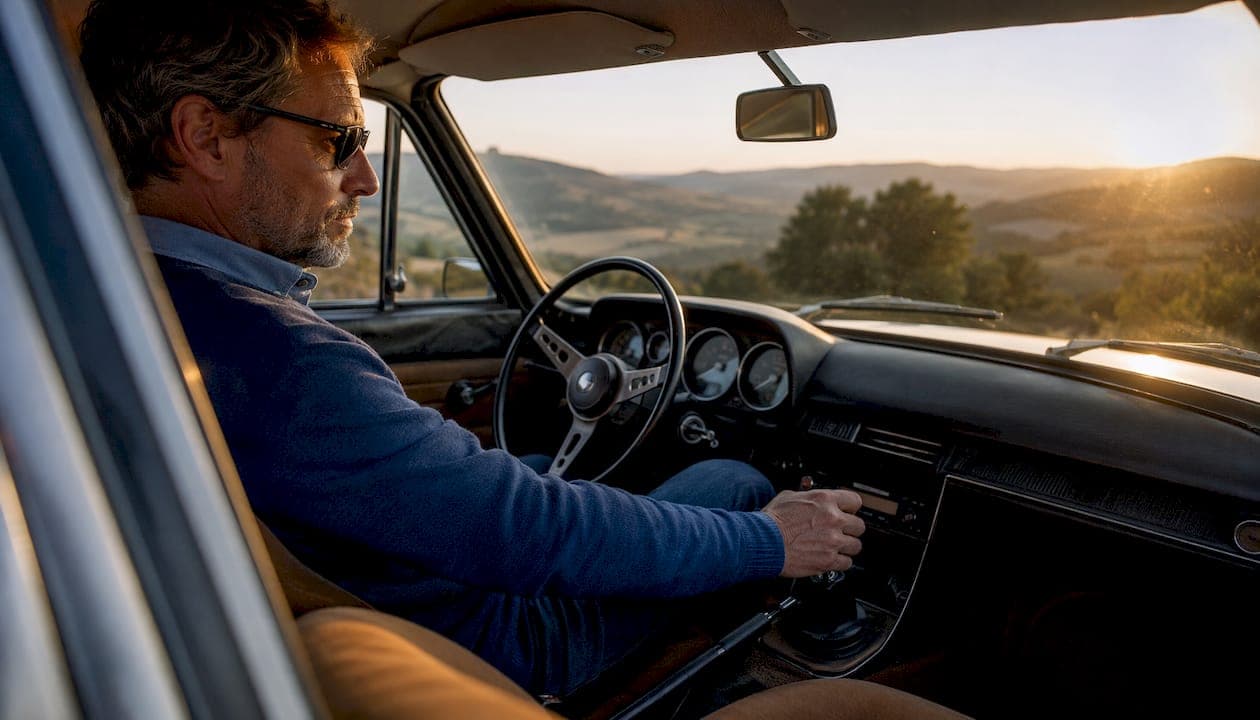
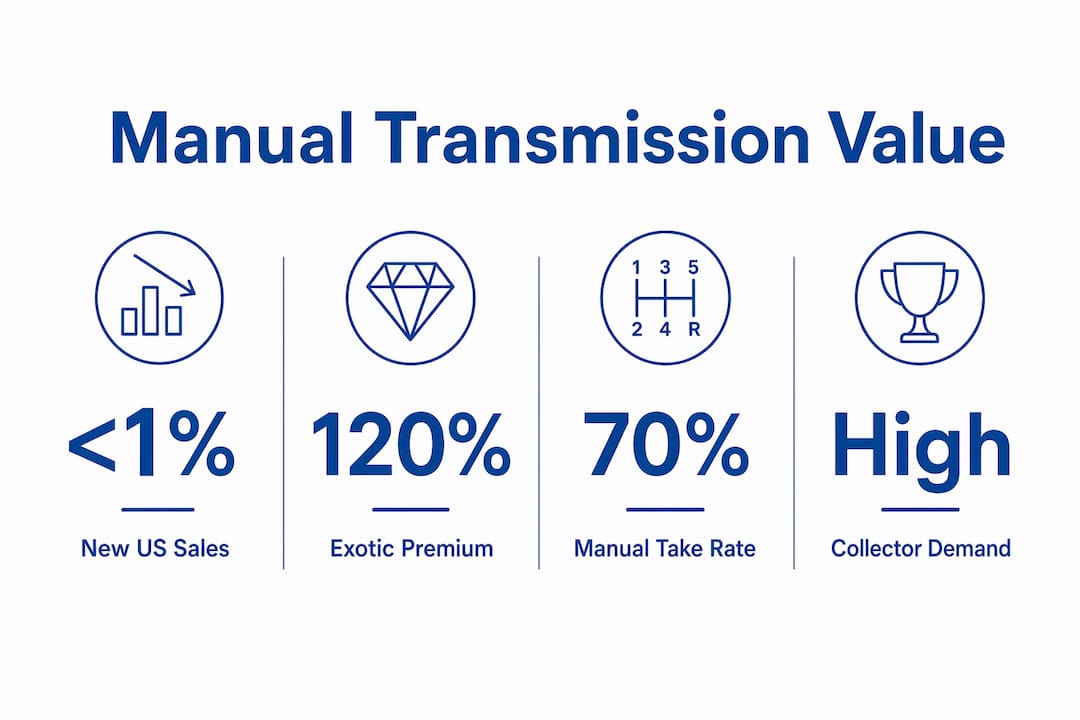
Manual transmission cars gain value because they are genuinely rare, and rarity drives price. As of 2026, manuals account for less than 1% of new vehicle sales in the United States. That scarcity, combined with a passionate buyer base willing to pay premiums, has turned the stick shift from a budget option into something closer to a collector's asset.
The core reasons manual transmission cars hold or increase their value:
- Supply-demand imbalance: Fewer new manuals produced means used examples face stronger competition among buyers.
- Enthusiast buyer profiles: Manual owners tend to be driving-focused, careful with maintenance, and less likely to abuse a vehicle.
- Price premiums on specific models: Manual Ford Mustang GT listings average $6,000 more than automatics; manual Subaru WRX listings average about $2,800 more than their automatic equivalents.
- Collectibility: Certain manuals, particularly performance and exotic models, are now treated as investment-grade hardware.
- Cultural shift: Younger drivers are increasingly drawn to the analog driving experience, sustaining demand even as supply shrinks.
Not every manual benefits equally. Economy cars with manual gearboxes often depreciate faster than their automatic counterparts. The value story is strongest for enthusiast models, performance vehicles, and exotics.
What drives manual transmission car resale values up?
The value of manual transmission cars does not rise uniformly. It concentrates in specific segments where buyer identity and vehicle identity align.
Market scarcity is the foundation. With fewer than 30 manual-transmission models available for the 2025 model year, the used market carries the weight of satisfying enthusiast demand that new car lots simply cannot meet. Buyers who want a three-pedal experience have limited options, and that constraint pushes prices up on desirable examples.
Buyer demographics sharpen the effect. Manual buyers skew toward enthusiasts and collectors, people who research purchases carefully, maintain vehicles well, and hold onto cars longer. That ownership pattern produces cleaner, better-preserved used examples, which command higher resale prices. The manual premium depends heavily on the vehicle's target demographic and model positioning, not the transmission alone.
The "manual tax" is real, but it is not universal. For enthusiast-focused models like the Ford Mustang and Subaru WRX, manuals typically sell for thousands of dollars more—on average about $6,000 and $2,800 more, respectively—reflecting buyers who value driving experience and performance heritage. When a car is already marketed as a dedicated sports vehicle, the transmission choice alone may not influence price as significantly.
Regional trends also matter. Urban markets with heavy traffic tend to show weaker manual demand, while markets with driving roads and enthusiast culture, think parts of the South, Pacific Northwest, and mountain states, sustain stronger interest. If you are shopping or selling a manual, timing and market conditions can shift the outcome meaningfully.
Pro Tip: When buying a manual for long-term value, prioritize enthusiast-focused models over economy cars. The Mazda MX-5 Miata, Ford Mustang GT, and Porsche 911 consistently outperform economy manuals in resale retention.
How manual ownership shapes the buying experience and long-term value
Manual ownership attracts a specific kind of driver, and that self-selection has real consequences for resale value.
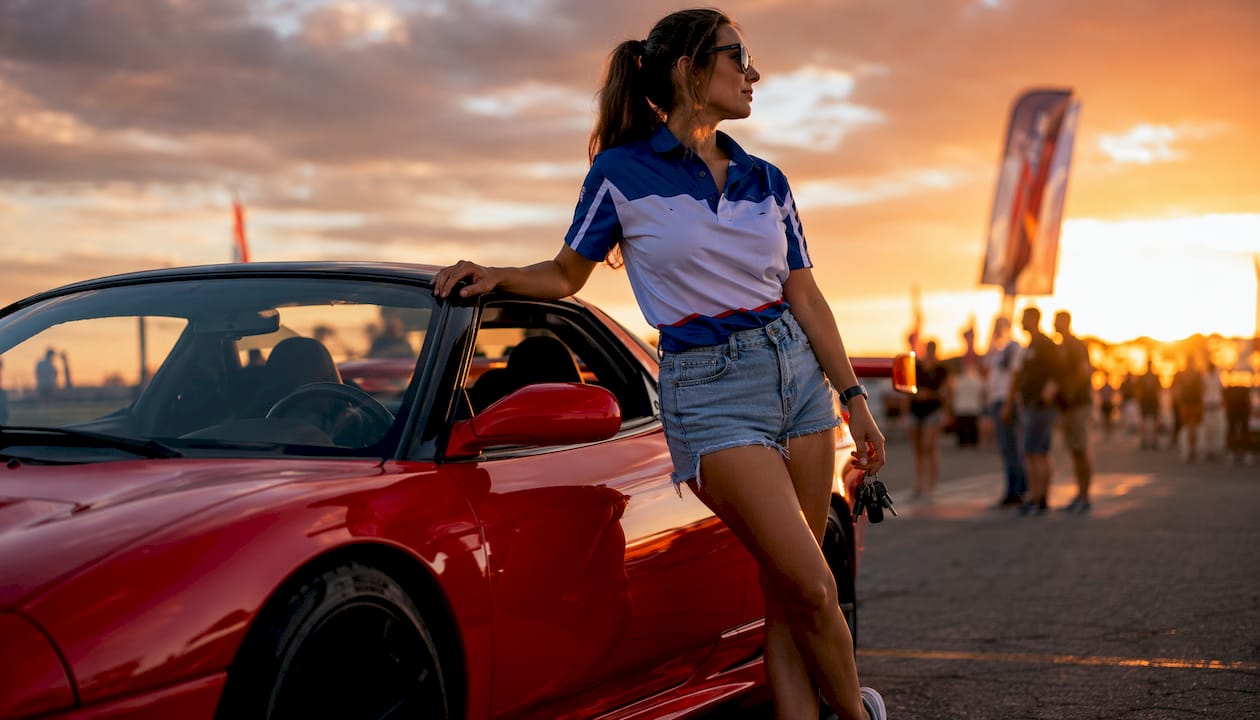
Drivers who seek out a manual are choosing involvement over convenience. The physical act of coordinating clutch, throttle, and gear lever creates what enthusiasts call "mechanical sympathy," an awareness of what the car is doing that automatic drivers rarely develop. That mindset carries over into ownership habits: more attentive maintenance, fewer hard launches, and a genuine interest in keeping the vehicle in good condition.
The perception of mechanical simplicity also plays a role. Traditional manual gearboxes have fewer complex electronic components than modern dual-clutch or torque-converter automatics, which can translate to lower repair costs on older vehicles. Buyers who enjoy working on their own cars gravitate toward manuals partly for this reason, and their hands-on approach tends to keep vehicles in better shape over time.
Fuel economy and performance perceptions add another layer. Manual drivers feel in control of gear selection, which reinforces the sense that they are getting the most from the engine. Whether or not a modern manual is more fuel-efficient than a comparable automatic, the perception of driver-controlled performance matters to the buyer segment that pays premiums. That perception sustains demand and, by extension, resale prices.
What experts and 2026 market data say about manual transmission value
The collector and enthusiast markets have been making the case for manual value for years. In 2026, the data is hard to argue with.
The Cadillac CT5-V Blackwing is the clearest current example. A four-year-old American performance sedan worth more than it cost new. A 2023 CT5-V Blackwing with 2,400 miles sold for $101,500 on Cars & Bids, against an original MSRP of $84,990. Another example with 6,800 miles brought $97,000 on Bring a Trailer. The manual transmission is central to that story: it is the last V8, rear-wheel-drive, manual-equipped American sedan, and buyers know it.
In the exotic segment, the premiums are even more dramatic. The Hagerty Price Guide assigns a 120% premium to a manual Ferrari 612 Scaglietti over its automatic equivalent. A manual Lamborghini Gallardo commands at least a 50% premium over the paddle-shift version. These are not marginal differences.
Younger buyers are part of the story too. Manual transmission is increasingly viewed as an analog luxury by a generation that grew up with touchscreens everywhere. The scarcity of new manuals has elevated the experience from a practical skill to something closer to a craft, and that cultural reframing is showing up in auction results and private sale prices alike.
Why manual transmissions make cars more collectible
Collectibility requires rarity, desirability, and a community that sustains both. Manual transmission cars check all three boxes, particularly in the performance and exotic segments.
Rarity is now structural. As manufacturers pivot toward electric vehicles and dual-clutch automatics, the pipeline of new manual cars is closing. Models like the CT5-V Blackwing are confirmed for discontinuation after 2026, which means the supply of new examples is finite. Collectors understand that once a configuration disappears, it cannot be recreated, and that understanding drives acquisition before the window closes. For a deeper look at how limited production shapes collector markets, the types of limited edition vehicles guide covers the broader pattern well.
Desirability in the collector market is reinforced by the Hagerty Price Guide, which assigns a premium to nearly every vehicle listed when a manual is available. The Ferrari 599 GTB Fiorano illustrates the extreme end: of 3,500 built, just 30 received a manual gearbox, and a 4,700-mile example sold at auction for $709,000 against a standard value of $245,000. That gap is not about performance specs. It is about scarcity and the experience the car represents.
Community sustains value over time. The Mazda MX-5 Miata recorded a 70% manual take rate in 2024, the highest of any model tracked. That concentration of manual buyers creates a deep aftermarket, active owner communities, and a steady pool of knowledgeable buyers when it comes time to sell. Strong community support is one reason luxury cars hold value more consistently than mass-market alternatives.
How car culture and community keep manual values strong
Manual transmission cars occupy a specific place in American car culture that no automatic can replicate. The stick shift is tied to motorsport heritage, to the idea that driving is a skill worth developing, and to a community that treats that skill as a shared identity.
Online forums, regional car clubs, track day organizations, and events like Cars and Coffee all skew heavily toward manual enthusiasts. That community creates a self-reinforcing market: buyers know where to find well-maintained examples, sellers know their audience, and the supply-demand dynamics of a shrinking manual market keep prices from softening. Aftermarket support for popular manual models, from short-throw shifter kits to clutch upgrades, also signals active ownership communities that protect long-term desirability.
The cultural dimension extends to how manuals are perceived as authentic. In a market where most performance cars now rely on software to deliver lap times, a manual gearbox introduces driver skill as a variable. That authenticity resonates with buyers who see the car as more than transportation, and it is precisely that buyer who pays a premium and maintains the vehicle carefully enough to sustain resale value for the next owner.
Key Takeaways
Manual transmission cars gain value primarily through scarcity, enthusiast demand, and the collectible status that follows when supply shrinks and a passionate buyer base remains.
| Point | Details |
|---|---|
| Scarcity drives premiums | Manuals account for less than 1% of new US car sales, pushing used demand and prices higher. |
| Model identity matters | Mustang GT manuals average $6,000 more and Subaru WRX manuals average about $2,800 more than automatics; economy manuals often depreciate faster. |
| Exotic premiums are extreme | Hagerty assigns a 120% premium to a manual Ferrari 612 Scaglietti over its automatic equivalent. |
| Community sustains value | The Mazda MX-5 Miata's 70% manual take rate in 2024 reflects the enthusiast base that keeps resale prices firm. |
| Collectibility is accelerating | The CT5-V Blackwing sold for $101,500 used against an $84,990 MSRP, driven by manual scarcity and no successor planned. |
Autovendorsfl specializes in sourcing quality vehicles for buyers who understand that the right car, maintained well and chosen carefully, holds its value. Browse the current selection of trucks and performance vehicles or contact the team directly for personalized vehicle-finding assistance.