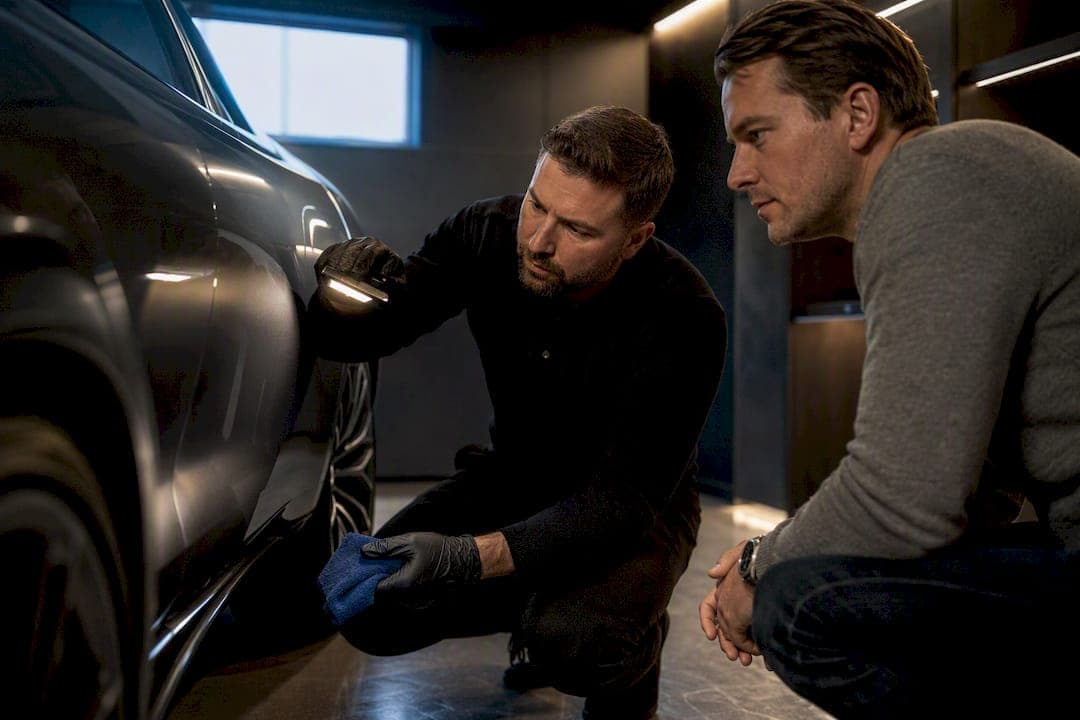
A dealer-led off-market sourcing service finds unlisted, private-sale vehicles and manages the purchase from first outreach to final delivery. Instead of scrolling public listings and auction sites, a buyer hands an agent a spec sheet and budget, then gets exclusive access to cars that never went up for sale publicly, along with negotiation support and coordinated inspection, transport, and paperwork.
TL;DR:
- Off-market sourcing provides exclusive access to vehicles that are not publicly listed, reducing competition and avoiding bidding wars on popular cars.
- The process relies on private networks, collector contacts, and VIN tracking to locate discreetly sold cars, often taking weeks or months depending on rarity.
- Conducting thorough due diligence, including VIN history, specialist inspections, and verifying ownership documents, is essential to avoid costly surprises.
- Fees generally include flat, commission-based, or retainer-plus-success models, with timelines varying from days to several months based on vehicle rarity.
- Reputable dealers insist on written mandates, proof of funds, staged payments tied to inspections, and verified provenance before completing a sale.
Table of Contents
- What Off-Market Car Sourcing Means for a Retail Buyer
- How Does the Off-Market Sourcing Process Actually Work?
- What Due Diligence Should Every Off-Market Buyer Complete?
- What Do Off-Market Sourcing Fees and Timelines Look Like?
- What Reputable Off-Market Dealers Do Differently
- Ready to Start Your Off-Market Search?
- Sources
What Off-Market Car Sourcing Means for a Retail Buyer
Off-market car sourcing, in the retail sense that matters to you as a buyer, is a personalized search service. A dealer or independent personal shopper works on your behalf to find a specific make, model, or trim that isn't sitting on a public lot or listed on a marketplace site. This is different from wholesale sourcing, where dealerships restock inventory through auctions and trade networks. Here, the service exists entirely for you, the individual trying to land a car that either doesn't show up for sale often or that you'd rather buy quietly.
The appeal comes down to a handful of practical advantages:
- Private access. You see cars that never get photographed for a listing site, because the owner or seller prefers a discreet sale.
- Reduced competition. Fewer eyes on the car means less of the bidding-war pressure that drives up prices on popular auction platforms.
- Tailored search. An agent filters for your exact spec, colorway, mileage band, and history instead of you sifting through hundreds of near-misses.
- Negotiation leverage. A dealer negotiating on your behalf, rather than you negotiating directly with a private seller, tends to produce a cleaner deal.
Agents build these leads through a mix of channels: private collector networks, restoration shops and specialist mechanics who hear when a client is ready to part with a car, estate sales, VIN tracking on cars that have gone quiet, and tight-knit marque communities where word of a sale travels before it ever hits the internet. Dealership vehicle sourcing for luxury buyers works precisely because it draws on relationships a solo buyer usually doesn't have.
How Does the Off-Market Sourcing Process Actually Work?
The workflow follows a fairly consistent pattern, whether you're chasing a specific SUV trim or a numbered classic.
- Submit a detailed brief. Give your agent the make, model, acceptable model years, must-have options, budget ceiling, timeline, and any absolute deal breakers. Vague requests slow everything down; precise specs paired with verifiable proof of funds let an agent prioritize your search over less-defined buyers competing for the same agent's time.
- Agent activates search channels. This usually means checking private owner databases, running VIN watchlists on specific cars known to exist, contacting restoration shops and specialist dealers, and reaching out to collectors under NDA when a listing needs to stay quiet.
- Quiet outreach and initial contact. Rather than a public "for sale" post, the agent approaches a known owner or seller directly, often signaling that a qualified, funded buyer is already lined up. Private buyer networks vet participants with ID checks, proof of funds, and signed mandates before inviting them into these conversations, which keeps the process serious on both sides.
- Negotiation. Your agent handles the back-and-forth, sometimes through escrow or attorney oversight for higher-value transactions, keeping your identity and offer details private until terms are close.
- Inspection, transport, and closing. Once you have a verbal agreement, the car goes through a mechanical inspection, then transport gets arranged, title transfers, and the paperwork closes out the deal.
Pro Tip: Give your agent a firm "walk away" number before negotiations start. A private seller can sense hesitation, and having a hard ceiling in writing keeps you from getting talked into a number you'll regret.
What Due Diligence Should Every Off-Market Buyer Complete?
Buying outside the public market removes the built-in paper trail that comes with a dealership sale, so verification carries more weight here, not less.
Before you even make an offer, run these checks:
- VIN history report to catch flood damage, salvage titles, or odometer discrepancies.
- Title and lien search confirming the seller actually owns the car free and clear.
- Maintenance and provenance records, especially for anything approaching collector status.
- Mechanical inspection from a marque specialist, not a generic shop, covering structural integrity and, for collectible models, matching-numbers verification.
- Title transfer paperwork, lien releases, and state registration requirements, plus a power-of-attorney form if the deal crosses state lines.
Skipping the specialist inspection is where most private-sale regret starts. Builder-level and marque-specialist inspections catch structural and mechanical issues that a casual walkaround misses, and that single step protects you from the kind of expensive surprise that shows up three months after you've already wired the funds. A shop like Artec Automotive, which specializes in exotic and European mechanical work, is the type of independent resource worth involving before money changes hands.
On the payment side, staged funds tied to inspection milestones, often through an attorney-managed escrow, protect both you and the seller in a higher-value private transfer. It's a small procedural step that removes most of the risk baked into paying a stranger directly.
What Do Off-Market Sourcing Fees and Timelines Look Like?
Fee structures vary by agent and by how hard the car is to find, but three models dominate the market:
- Flat search fee. A fixed price regardless of outcome complexity, good for buyers who want cost certainty on a moderately common model.
- Commission-based. A percentage of the final purchase price, which aligns the agent's incentive with getting you the best deal, though it can get expensive on high-value cars.
- Retainer plus success fee. A smaller upfront payment to start the search, with a larger fee due on a completed purchase, common for genuinely rare finds.
Timelines follow rarity. A common luxury sedan in decent supply might turn up in days to a few weeks. A specific numbered classic or a discontinued trim can take months of quiet outreach before the right owner surfaces.
Budget beyond the sticker price for inspection fees, insured enclosed transport, title and documentation costs, and any pre-delivery service work. If the car is coming from overseas, factor in import-related charges as well. Insist on a written sourcing agreement that ties fees to specific milestones, with clear refund or escrow terms if the search stalls. A vague verbal handshake is not a substitute for terms on paper.
What Reputable Off-Market Dealers Do Differently
Most of the risk in off-market buying isn't the car, it's the process around it. I've seen buyers get burned less by mechanical problems than by loose verbal agreements and agents who never put a mandate in writing.
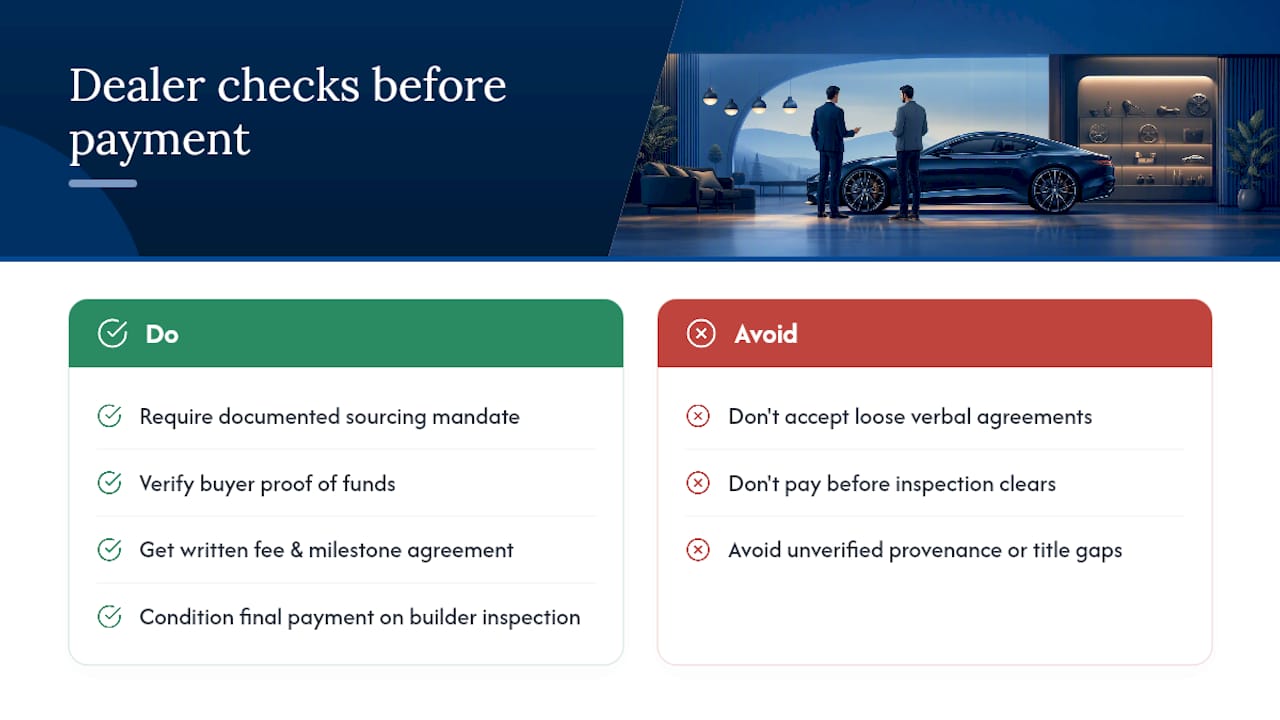
Insist on four things before you hand anyone money: a documented sourcing mandate, verified proof of funds on your end, a written agreement spelling out fees and milestones, and a builder-level inspection before final payment clears. Staged payments tied to inspection results aren't a formality. They're the single clearest sign an agent knows how this business actually works.
That means hands-on outreach into private networks, provenance verification before a car ever reaches your inspection stage, and direct coordination of transport and title work so nothing falls between two parties pointing fingers at each other. For readers who want to go deeper, our guides on pre-purchase inspection and documenting a rare vehicle acquisition cover the mechanics in more detail than any single article can.
— Allen
Ready to Start Your Off-Market Search?
Personalized sourcing the way it should be done: one dedicated point of contact, direct outreach into private seller networks, and full coordination from first lead to final delivery, all for one buyer at a time instead of a lot full of walk-in shoppers.
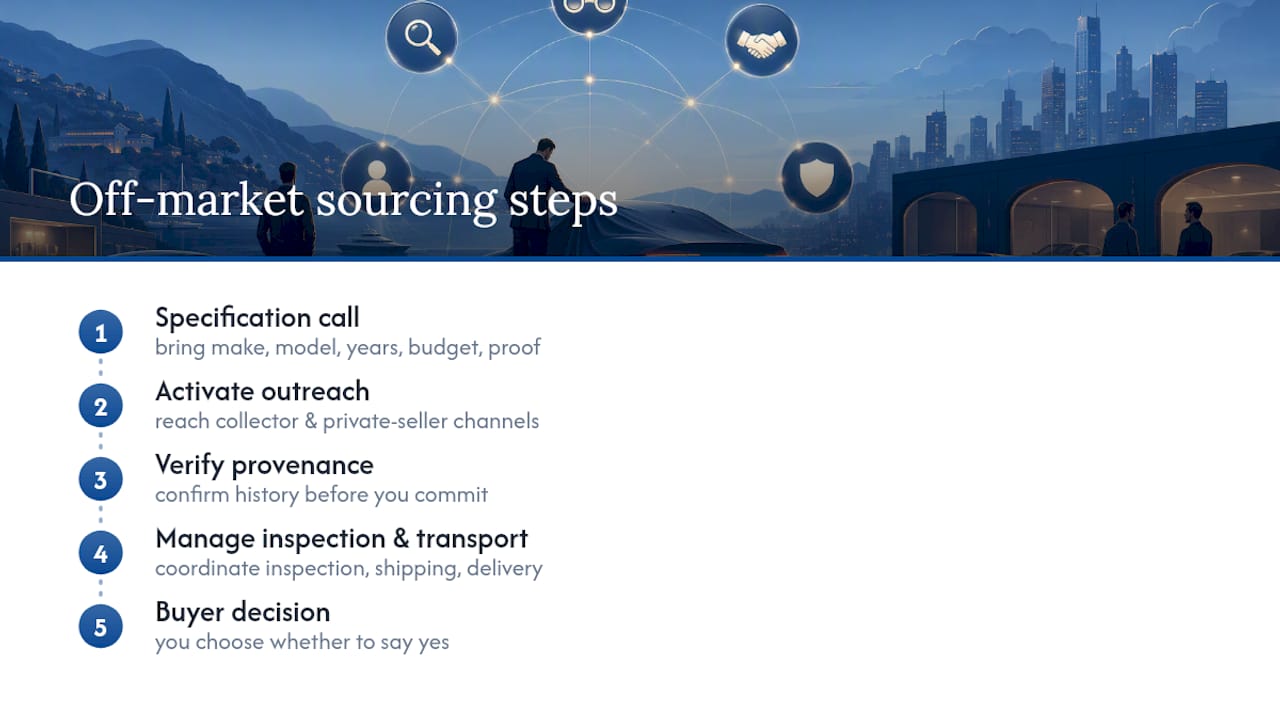
 Your first call is a specification conversation, not a sales pitch. Come prepared with your target make and model, acceptable years, budget ceiling, and any non-negotiables, plus proof of funds and any existing inspection or provenance documents if you've already looked at a specific car. From there, we activate outreach into collector and private-seller channels, verify provenance before you commit to anything, and manage inspection and transport so the only decision left in your hands is whether to say yes.
If you're ready to see what's currently within reach, browse our current inventory or reach out to start a sourcing conversation. The right car rarely announces itself publicly. Finding it is exactly what we do.