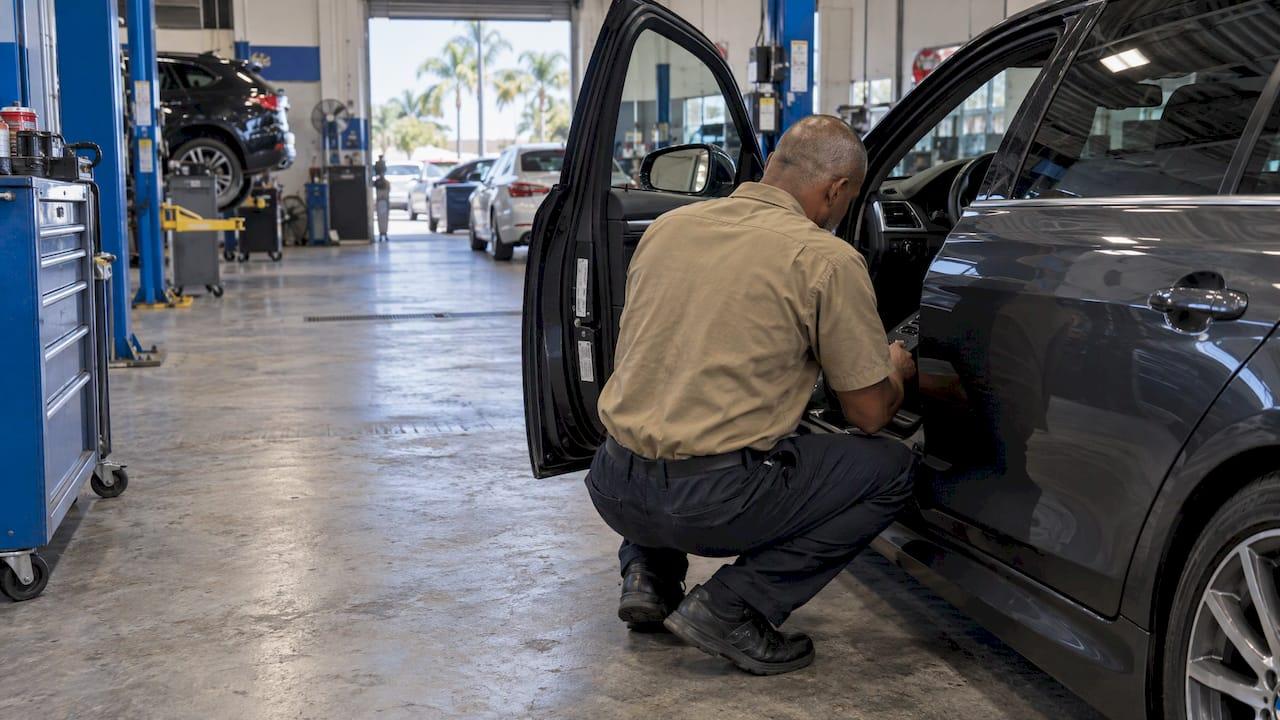
A gray market car is a vehicle built for another country's market and brought into the U.S. outside the manufacturer's normal channels. The main risks are practical: it may not be eligible for a U.S. title or registration, some insurers will not cover it, and parts and service can be hard to arrange. For most buyers, a used luxury car that was originally sold new in the U.S. and carries a U.S. title removes nearly all of that uncertainty. A dealer that finds that car for you is the simplest way to get there.
This guide explains each risk in plain terms, what the federal and state rules say, and what to confirm before you sign anything.
TL;DR
- A gray market car was never titled in the U.S. and often was not built to U.S. safety and emissions standards, so a state may refuse to title or register it.
- Insurance is the next hurdle: some insurers decline these cars, offer liability only or require high deductibles.
- Federal rules generally keep a car under 25 years old out of the country unless it is brought into compliance by an approved importer.
- Check the manufacturer's label, the VIN, the title and the import paperwork before you pay, and line up insurance before you drive.
- A U.S.-market used car with a clean U.S. title avoids these problems, and our Car Finder service is built to locate one.
Table of Contents
- What "gray market" means in the U.S.
- Risk 1: The car may not be titled or registered
- Risk 2: Insurance can be harder and costlier
- Risk 3: Title brands, hidden history and resale value
- Risk 4: Labels, parts, service and warranty
- Risk 5: The federal import rules are strict
- A pre-purchase checklist
- How the risk looks in practice
- When a foreign-market model is worth pursuing
- Our perspective
- Find your car with Auto Vendors
- FAQ
- Sources
What "gray market" means in the U.S.
The term is easy to misread. It does not mean stolen or illegal. The Maryland MVA describes a gray market vehicle as one brought to the U.S. from overseas that has never been titled here, and it may or may not have been produced overseas. What matters is that the car did not come through the manufacturer's U.S. distribution.
That difference matters because U.S. cars are built to Federal Motor Vehicle Safety Standards (FMVSS, the Department of Transportation's safety rules) and to EPA emissions rules. A car made for Europe, Japan or the Middle East may differ in bumpers, lighting, airbags, emissions equipment and instrument labeling. Connecticut's DMV puts it this way: a grey-market vehicle was not originally built to meet U.S. safety and emissions standards, may need modification after import, and must be approved by the EPA and DOT before it can be registered.
Pennsylvania's DMV adds a detail worth knowing: today the term applies mostly to European-built cars not certified for U.S. use, and even Canadian-market vehicles may not meet U.S. standards. A car that looks American can still be a gray market car.
Risk 1: The car may not be titled or registered
This is the risk that ends the purchase. Titling and registration are what make a car legal to drive, and states will not issue them to a car that has not cleared federal requirements.
The Maryland MVA says a nonconforming overseas vehicle cannot be titled or registered until it is brought into compliance, and if it cannot be brought into compliance, no title or registration will be issued. Maryland also asks for a long list of documents, including a safety inspection certificate and customs release records.
Other states set their own paths:
- California: a direct import not built to California emissions and federal safety standards cannot be registered unless it is modified and tested under the state's direct import program. The DMV also asks for stamped customs forms and, for many vehicles, a smog certificate.
- Wisconsin: a vehicle without a federal certificate label or a registered importer label can be titled only with a "NON USA STANDARD" brand and registered only as a special interest (collector) vehicle.
- Pennsylvania: a nonconforming car brought into compliance receives a title branded "G" for non-U.S. distribution.
- New York: the DMV can require New York's own safety and emissions standards even when a vehicle meets or is exempt from federal ones, and it will not title a Kei-class vehicle without proof of full federal compliance.
The lesson: the rules depend on your state, so the question to answer before purchase is whether your state will title and register this exact car. Answer it before you pay, not after.
Risk 2: Insurance can be harder and costlier
A car you cannot insure is a car you cannot responsibly drive. The New York Department of Financial Services lists gray market vehicles among those some insurers refuse or restrict. Some offer liability coverage only, some require physical-damage deductibles over $1,000, and some insure only vehicles under a stated age. The department advises checking insurability and cost with an insurer, agent or broker before you buy.
Why the friction? Insurers rely on databases that identify a car by its VIN and price its repairs and replacement from U.S. comparables. A car with no U.S. counterpart is hard to value after a total loss, and its parts may have to be shipped from abroad. Specialty coverage exists. One carrier's imported and gray-market program, for example, uses an agreed value and requires that the vehicle was legally imported and registered, with the customs, EPA and DOT paperwork kept on file. Cars not legally registered for U.S. roads are not covered.
That last point connects the first two risks. Without compliant paperwork, you may not be able to register the car, and without registration, even specialty insurance may not apply.

Risk 3: Title brands, hidden history and resale value
A gray market car's title tells a story. The California DMV lists "gray market" among its common title brands and defines the Non-USA (Grey market) brand as a vehicle originally manufactured for sale and use outside the United States but converted to meet federal and California standards. A brand like that follows the car to every later owner, and buyers and lenders notice it.
History is the second concern. A foreign-market car has no U.S. service history, and a standard U.S. history report may show little or nothing about its life abroad. The Tennessee Department of Commerce & Insurance recommends running both an NMVTIS and a CARFAX report to check a car's real history. NMVTIS is the federal National Motor Vehicle Title Information System. It shows the true state and title number on record, and a mismatch with the seller's claimed out-of-state title suggests a fake title.
If you are weighing branded titles in general, our guide on clean versus rebuilt titles shows how much a brand can change what a car is worth.
Resale is the quiet cost. A car that is harder to title, harder to insure and harder to explain is a smaller pool of buyers when you sell. Plan the exit before you commit to the entrance.

Risk 4: Labels, parts, service and warranty
The quickest field test is the manufacturer's label, usually on the driver's door jamb. PennDOT advises inspecting it to verify the car was intended for U.S. distribution. A U.S.-spec car carries a statement of conformity to federal standards. A foreign-market car often shows different wording or none. Compare the VIN on the dashboard and the door jamb as well; Arizona's MVD includes that step in its car buying checklist.
Parts and service follow from the label. Dealers and independent shops know U.S.-spec models. A car with different engines, electronics or lighting can mean longer waits for parts and fewer technicians who have worked on it. Warranty is a separate question: manufacturer coverage is typically written around U.S. distribution, so ask in writing what, if anything, applies to the car you are considering. For how warranty and parts questions work for owners of foreign-market cars, see this explainer on warranty rights for foreign-market cars.
Service records matter just as much. Our five-step method for verifying service records applies to any used luxury car, and it is harder to complete when the car's history sits in another country.
Risk 5: The federal import rules are strict
Some buyers hope to bring a car in themselves. The federal framework is built to stop that unless the car qualifies.
- Customs paperwork. U.S. Customs and Border Protection requires EPA Form 3520-1 and DOT Form HS-7 at entry. A vehicle that does not meet U.S. emissions rules must come in through an EPA-certified independent commercial importer, and EPA no longer grants a one-time exemption for vehicles five or more model years old.
- The 25-year rule. NHTSA says a nonconforming vehicle less than 25 years old cannot be permanently imported unless NHTSA finds it eligible, typically through a registered importer who can bring it into compliance.
- Temporary use. A nonresident importer can bring a vehicle in for personal use for up to a year under 19 CFR 12.73(g), but only on the condition that it is not resold in the U.S.
The practical meaning: a car under 25 years old that has not been converted by a registered importer is the highest-risk kind of gray market purchase. For older cars the rules are different, and our explainer on what the 25-year import rule covers and what it doesn't walks through them. Tariff and duty rules for imports have also changed more than once recently, so treat any seller's claim about duty already paid as something to confirm with customs paperwork.
A pre-purchase checklist
Whether the car is a true gray market import or just "might be," these steps protect you. They line up with what state agencies and consumer alerts recommend.
- Read the manufacturer's label. Confirm the car was built for U.S. distribution. If the label is missing or in another standard, treat the car as nonconforming until proven otherwise.
- Match the VIN. Compare the dashboard and door jamb numbers to the title and to each other, as Arizona's checklist advises.
- Check the seller against the title. The seller's name should match the title owner. Look for brands, alterations and liens.
- Pull history reports. Run NMVTIS and a commercial report, and compare the state and title number they show to what the seller claims.
- Collect the import paperwork. For any car that entered from overseas, ask for the customs entry summary (CBP Form 7501), HS-7 and EPA 3520-1, plus translated foreign documents where relevant. States such as New York require certified English translations.
- Ask your state. Confirm with your DMV that this specific car can be titled and registered, and whether a safety or emissions inspection is required.
- Get insurance in writing first. Give each insurer the exact year, make, model, trim and VIN, and ask how they will value the car in a total loss. Do this before delivery, not after.
- Have an independent mechanic inspect it. Arizona's MVD recommends a reputable mechanic for any used purchase.
- Apply for the title promptly. Arizona's checklist notes a 15-day window to apply after purchase, and other states set their own deadlines.
If the car is out of state, read our three steps for buying a car sight unseen before wiring money, and use the used car paperwork guide to avoid DMV delays.
How the risk looks in practice
Imagine a buyer who finds a European luxury sedan listed far below comparable U.S. cars. The listing says "imported, runs great." Three things need to line up before it is a good deal: the label shows U.S. conformity or a registered importer's certification, the buyer's state will title it, and an insurer will write a policy on an agreed or fair valuation. If any one fails, the price gap is not a saving. It is the cost of a problem the buyer has taken on.
The same logic applies to families shopping for an SUV or minivan. A model sold in other regions may look identical to the U.S. version, but if the safety equipment or emissions package differs, the state can decline it. For a vehicle that carries children every day, a fully U.S.-certified car is the sensible baseline.
When a foreign-market model is worth pursuing
Some enthusiasts want a model the U.S. never officially sold, and that is a legitimate goal. The path is narrower: a car that is old enough to qualify under the federal age rules, or one that a registered importer has already brought into compliance, with the paperwork to prove it. Documentation is everything here. Our collector's checklist for documenting a rare vehicle acquisition lists what to keep, and the 2026 guide to unique foreign market models shows which cars make sense. If you want something rare, working with a professional locator who runs VIN checks is far safer than answering an online listing.
Our perspective
Most of the gray market stories we hear start with a price that looked too good. The buyer saw a luxury car well under the going rate and treated the gap as a win. The gap was usually the cost of compliance, insurance and resale that someone else had decided not to pay.
We built our approach around the opposite idea. A premium car should come with a clear history, a title your state will accept and paperwork you can read. That is why we focus on a curated selection of quality used and luxury vehicles, and why we offer personalized vehicle finding for buyers who want a specific make, model or body style.
If you want something unusual, tell us. We would rather locate the right car with documents behind it than hand you a puzzle to solve after you have paid.
Allen
Find your car with Auto Vendors
If you want the luxury car without the paperwork gamble, start with our inventory. You can search by make, model, body style and price, and browse SUVs, sedans and the rest of our used vehicles for sale in Fort Lauderdale. Trade-in valuation and financing options are part of what we offer, so you can handle the whole purchase in one place.
Can't find the exact car? Our Car Finder service is there for that. Tell us what you want, and we will look for it.
FAQ
Are gray market cars illegal?
Not by themselves. Federal law allows a car to be imported if it conforms to U.S. standards or is brought into compliance through an approved importer, and CBP requires EPA and DOT forms at entry. The trouble comes when a car does not meet those standards and cannot be titled or registered.
Is it harder to insure a gray market car?
Often, yes. New York's insurance regulator says some insurers refuse these vehicles, limit them to liability coverage, require deductibles over $1,000 or cap the vehicle's age. Ask insurers whether they will write the exact car, and on what valuation, before you buy.
How can I tell if a car is gray market?
Start with the manufacturer's label and the VIN, then check the title for a "gray market" or "non-USA" brand and ask for the import paperwork. A history report and an independent inspection add confirmation. If the car has a U.S. title from a U.S. first sale, it was not imported through gray channels.
Can I register a gray market car in any state?
No. Each state sets its own requirements. California, New York, Maryland, Wisconsin and Pennsylvania all handle imports differently, and some cars can be registered only as collector vehicles or not at all. Confirm with your own DMV before paying.
Sources
- Maryland MVA: Title and registration for vehicles coming from overseas
- Connecticut DMV: Inspections for imported vehicles
- Pennsylvania DMV: Import-export FAQs
- California DMV: Register an imported vehicle
- Wisconsin DOT: Foreign vehicle titles
- New York DMV: Register an imported vehicle
- New York DFS: Difficult-to-insure vehicles
- Societies Insurance: Imported and gray-market vehicle insurance
- California DMV: Branded titles
- Tennessee Department of Commerce and Insurance: Consumer alert
- Arizona MVD: Car buying checklist
- U.S. Customs and Border Protection: Importing a motor vehicle
- NHTSA: Importation and certification FAQs
- eCFR: 19 CFR 12.73
- Warranty rights for foreign-market cars