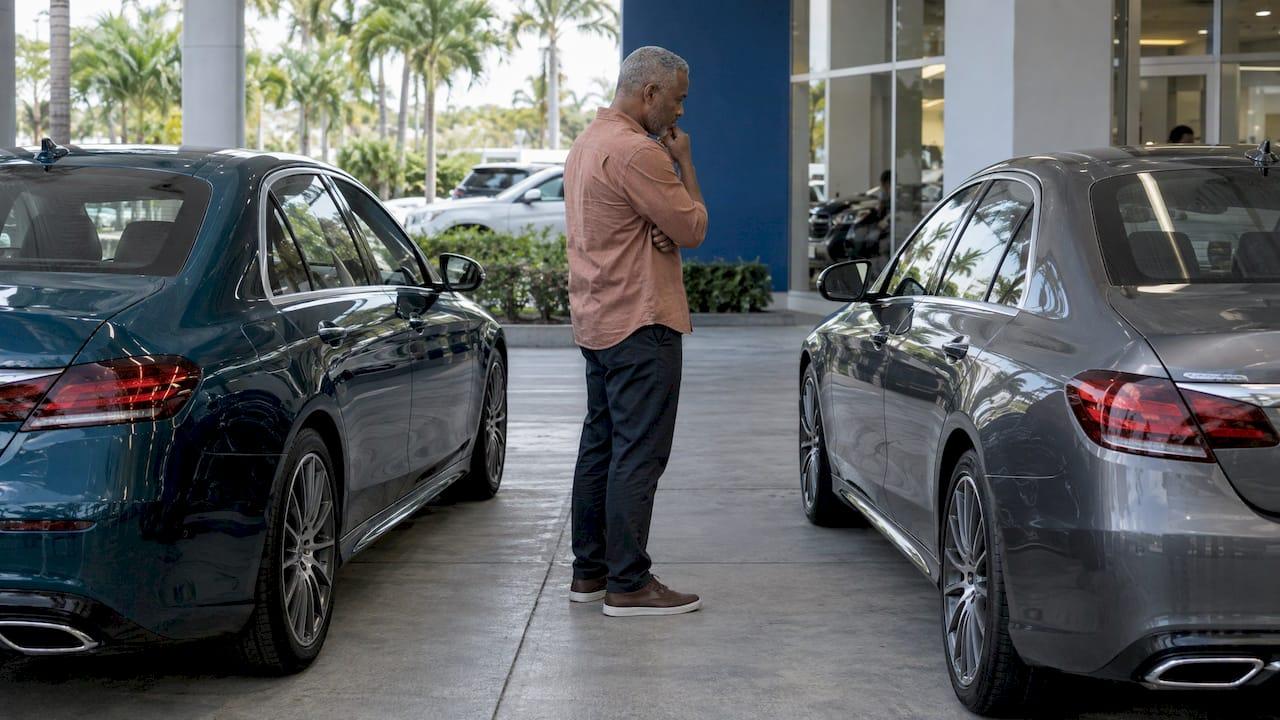
A one-owner car is not automatically the better car, and a former fleet car is not automatically the riskier one. Both labels describe who held the title, not how the car was driven, serviced or stored. The better buy is the one with the stronger paper trail and a clean inspection, whichever label it wears. If you are shopping for a luxury sedan, a family SUV or a minivan, that rule saves you from paying extra for a label and from passing on a good car because of one.
If you tell us what you want, our Fort Lauderdale team can run the Car Finder search for you and shape it around the ownership history you prefer, so you do not have to sort through every listing yourself.
TL;DR
- "One owner" means one title holder. It can be a person, a leasing company or a business, so it does not prove gentle private use.
- "Fleet" means the car was owned or leased by an organization rather than a person or family. Fleets range from municipal vehicles on strict service schedules to hard-working trucks.
- A car can be both: a company can be the single owner for years, even if many drivers used the car.
- Service records, a vehicle history report and a hands-on inspection tell you far more about condition than the owner count does.
- Fleet history can lower the asking price, which helps if the records check out.
Table of Contents
- What "one owner" really means
- What counts as a fleet car
- Can a car be both one-owner and ex-fleet?
- How each label affects price
- Condition: records beat labels
- One owner or fleet: which suits which buyer?
- Questions to put to any listing
- Let us find the car for you
- Our perspective
- FAQ
- Sources
What "one owner" really means
In a vehicle history report, an owner is an individual or a business that possesses and uses a vehicle. CARFAX's own glossary adds two details buyers rarely hear. Not every title transaction represents a change of ownership, and the estimated owner count is based on vehicles titled in the United States.
So a one-owner car has had one title holder over the period the report covers. That tells you the car was bought once and kept. It does not tell you the owner changed the oil on time, parked in a garage or drove gently. Bumper's ownership-history guide makes the same point: a single owner indicates a single owner, not careful maintenance or good condition.
The label also has quirks that can work in your favor or against you:
- An extra owner can be administrative. The CARFAX glossary notes that dealers are required to take ownership of a vehicle in Maine, Massachusetts, New Jersey, Ohio, Oklahoma, Pennsylvania and South Dakota, which can affect the estimated count. A car that looks like a two-owner vehicle on paper may have had one real owner.
- A one-owner car can have a short life with that owner. Someone who bought it new and traded it at 14 months is one owner. So is someone who kept it for 11 years.
- Owner type matters. A history report can show whether the owner was personal or corporate, how long each owner kept the car and the estimated miles driven per year. That is more useful than the count alone.
For a deeper walk through reading these reports, see our guide to how to verify a luxury vehicle history report.
What counts as a fleet car
There is no single legal definition. A fleet vehicle is generally one owned or leased by a business, government agency or other organization rather than by an individual or family. Think rental companies, taxi services, utilities, municipalities and corporate motor pools.
How many vehicles make a fleet depends on who is asking. For commercial insurance, the CAR Commercial Automobile Insurance Manual treats any risk with five or more self-propelled automobiles under one ownership as a fleet. Other organizations draw the line lower. For you as a buyer, the practical question is simpler: was this car titled to an organization, and what did that organization use it for?
That second question is where fleet cars split into very different groups:
| Fleet type | Typical use | What to expect |
|---|---|---|
| Government and municipal | Administrative and fieldwork driving | Often documented and serviced on a schedule, and retired at predictable mileage |
| Corporate executive or sales | Commuting and client travel | Varies with company policy and how drivers cared for the car |
| Rental | Short trips by many drivers | Many hands on the wheel, but typically regular turnover and maintenance |
| Commercial work | Towing, hauling, daily job-site use | Wear can exceed what the odometer suggests |
Bumper's guide describes the same spread: government fleets can be excellent used values when service history is available, while a pickup that towed daily has a different wear profile than a commuter pickup with the same mileage. Luxury buyers usually meet fleet history in the form of executive sedans, corporate-leased SUVs and former press or demonstration cars. The last category is a niche in its own right, and we cover why collectors and investors pay attention to it in our piece on press fleet vehicles.
Can a car be both one-owner and ex-fleet?
Yes, and this is the single most useful fact in the whole debate. Owner count increments when a vehicle is retitled to a new legal entity. A leasing company, a corporation or a fleet management company can hold the title for the entire time and register as one owner, even if several employees drove the car in turn.
That means an advertisement saying "one owner" and a history report showing corporate ownership are not in conflict. The ad is accurate by the count. The report tells you the rest. Look for the owner type line, and treat it as a separate piece of information from the count.
It works in reverse too. A car with two owners could be a lightly used personal car that moved from one household to another with every service stamp in place. The label alone cannot rank these cars. Your documents can.
How each label affects price
Buyers tend to pay more for a one-owner car because the label suggests simplicity and care. Fleet history tends to push prices the other way, because some shoppers avoid it on principle.
The discount is real in the data, though the best published figures are dated. In its December 2011 market report, Kelley Blue Book found that high-fleet compact cars sold at auction about $2,200 below the segment average, with an example of a 2008 Chevrolet Cobalt with 60,000 miles at $7,900 against a $10,000 segment average. Fleet-heavy crossovers sold about $500 below average. The same report observed that rental-fleet vehicles then appreciated in value as dealers looked for affordable inventory. Market conditions change, so use those figures as an illustration of the pattern rather than a quote for today.
The lesson for your budget is straightforward:
- A one-owner premium is paying for a story. It is worth paying only if the records support it.
- A fleet discount is paying for a gap in confidence. It is worth taking only if the records close that gap.
- Compare like with like. Same year, trim and mileage, and weigh the price difference against what the paperwork shows.
If you are a first-time luxury buyer watching affordability, this is where fleet history can help. A well-documented former corporate or government car may bring a premium badge into reach that a one-owner example of the same model would not. Our look at why pre-owned luxury beats new car cost covers the broader math.
Condition: records beat labels
Mileage and owner count are both shortcuts. Consumer Reports' used-car inspection guide offers a better one. Its advice is to ask whether the car averages more than 20,000 or fewer than 5,000 miles a year and why. It also notes that a high-mileage car used on a long highway commute may have less wear than one doing short stop-and-go trips, and that an organized pile of repair and maintenance documents usually indicates the car has been cared for.
That applies equally to both kinds of car. A highway-mile sales car and a low-mile garage car can each be excellent, and each can hide neglect. Here is how to read the evidence in order.
Step 1: Pull the history report and read the owner lines
Check the estimated owner count, owner type, length of each ownership, states where the car was titled and estimated miles per year. A report is built from information supplied to the reporting service, so it can miss events that nobody filed, such as a minor repair paid in cash. Use it as a starting map, not a verdict.
Step 2: Read the service records, not just their thickness
Organized maintenance records can show oil and filter intervals, cooling-system work, brake service, tire replacement, recalls and major component replacements. J.E.B. Insurance's fleet-purchase checklist adds that a stack of invoices is not automatically proof of good maintenance. Look for long gaps, repeated roadside repairs, mismatched mileage and recommendations that were never carried out.
Fleet cars often have an advantage here, because organizations that track vehicle costs tend to keep invoices. Our five-step guide to verifying service records shows how to cross-check dates and odometer readings. If you want to understand what a good record looks like from the shop side, this walkthrough on documenting car repair history explains what a complete file should contain.
Step 3: Check for open recalls
Consumer Reports advises checking for open safety recalls on any used car. A fleet that kept up with service often kept up with recalls, but verify it for each vehicle rather than assuming.
Step 4: Inspect the car itself
A clean history and a tidy file still need a physical check. J.E.B. recommends an inspection by a qualified person who does not depend on the sale, covering brakes, steering, suspension, tires, frame, electrical systems, leaks, cooling, driveline, emissions and body condition, with written findings and repair priorities. A former fleet car deserves extra attention to interior wear, seat and pedal condition, and underbody signs of hard use. For a luxury model, our pre-owned luxury inspection checklist lists what to look at, and why pre-inspection matters explains how it protects your purchase.
Step 5: Match the car to your use

A family SUV that will carry children and luggage should be judged on brakes, tires, suspension and cabin condition. A weekend coupe will matter on engine and transmission behavior. An executive sedan for a busy professional should be judged on comfort, electronics and quiet. The same history can be perfect for one of these and wrong for another.
One owner or fleet: which suits which buyer?
| If you are... | Lean toward | Why |
|---|---|---|
| A first-time luxury buyer watching the budget | A documented ex-fleet or corporate car | Fleet history can ease the asking price, and good records offset the label |
| A family needing an SUV or minivan | Whichever has the strongest records and inspection | Reliability and safety items matter more than the owner count |
| A busy professional | A car with a complete file | Less time spent chasing paperwork and fewer surprises |
| An enthusiast hunting a specific model | The right car, regardless of label | Rare trims are scarce, so flexibility on ownership history widens the field |
| A discerning luxury buyer | One-owner with a verified private history, or a well-kept corporate car | Condition and provenance matter, and both can be proved on paper |
If you want a broader view of buying in this segment, start with our smart buyer's guide to used luxury cars. If low mileage is part of your wish list, why super low mileage cars matter explains the trade-offs. And if you are weighing a lease against buying, our lease vs. buy checklist is a useful next read.
Questions to put to any listing
Whatever label the listing carries, a few direct questions sort the strong cars from the weak:
- Who was the owner, and was it a person, a business or a government body?
- How long did each owner keep the car, and where was it registered?
- How many miles a year does the history suggest?
- Where are the service invoices, and do the odometer readings line up?
- Are there open recalls?
- Has the car had a hands-on inspection with written findings?
A seller who can answer these quickly has usually kept good files. That matters more than whether the answer to the first question is "one person" or "one company."
Let us find the car for you
Sorting through listings for the right history is slow, especially when your time is limited. Our Car Finder is a personalized vehicle-finding service: you describe the make, model, body style and budget, and we look for cars that fit. You can also browse our used inventory by make, model, body style and price, including SUVs, sedans and the wider used inventory. We also offer trade-in valuation and financing options, so the car, the trade and the payment can be handled in one place at our Fort Lauderdale dealership.

Our perspective
We think the one-owner versus fleet debate is the wrong first question. Buyers arrive asking which label is safer, and we understand why: it is a simple filter in a market full of unknowns. But a label describes a title, and a title is not a car.
What we care about is the match between the vehicle and the person buying it. A busy professional needs a car with a complete file and no surprises. A family needs an SUV or minivan whose brakes, tires and cabin are in honest shape. An enthusiast chasing an unusual model needs someone who will look beyond the first page of listings. That is why we built our service around personalized vehicle finding rather than a single fixed rule about ownership.
Our focus is a curated selection of quality used and luxury vehicles, chosen with attention to elegance, craftsmanship and innovation. When a car's history is a little different, whether one owner, a corporate lease or a former fleet vehicle, the question is whether it earns its place. If it does, the story behind it is part of its value, not a reason to look away.
Tell us what you need and what history you are comfortable with, and we will go to work on it.
Allen
FAQ
Is a one-owner car always better than a fleet car?
No. One owner means one title holder, which could be a person or a company, and it says nothing about how the car was driven or maintained. A fleet car with complete service records can be a stronger purchase than a one-owner car with no paperwork.
Are ex-fleet cars cheaper?
Often they are priced lower, because many shoppers hesitate over fleet history. In its December 2011 report, Kelley Blue Book found high-fleet compact cars about $2,200 below their segment average at auction. Today's gap depends on the model and the market, so compare each car against similar ones.
How do I know if a used car was a fleet vehicle?
A vehicle history report shows owner type, such as personal or corporate, along with how long each owner kept the car and the states where it was titled. A corporate or government owner points to fleet use. The service records should then show how it was maintained.
What is considered a fleet vehicle?
It is a vehicle owned or leased by a business, government agency or other organization rather than by an individual or family. The size of a fleet varies by who defines it: the CAR commercial insurance manual uses five or more vehicles under one ownership.
Can a one-owner car have been used as a company car?
Yes. A leasing company or business that holds the title the whole time shows up as a single owner, even if many drivers used the car. Read the owner type line on the history report to see who that owner was.
Sources
- CARFAX car information and glossary
- Bumper: Vehicle Ownership History
- CAR Commercial Automobile Insurance Manual, Section IV
- Kelley Blue Book Market Report, December 2011
- Consumer Reports: How to Inspect a Used Car
- J.E.B. Insurance: Buying Fleet Vehicles Inspection and Cost Checklist