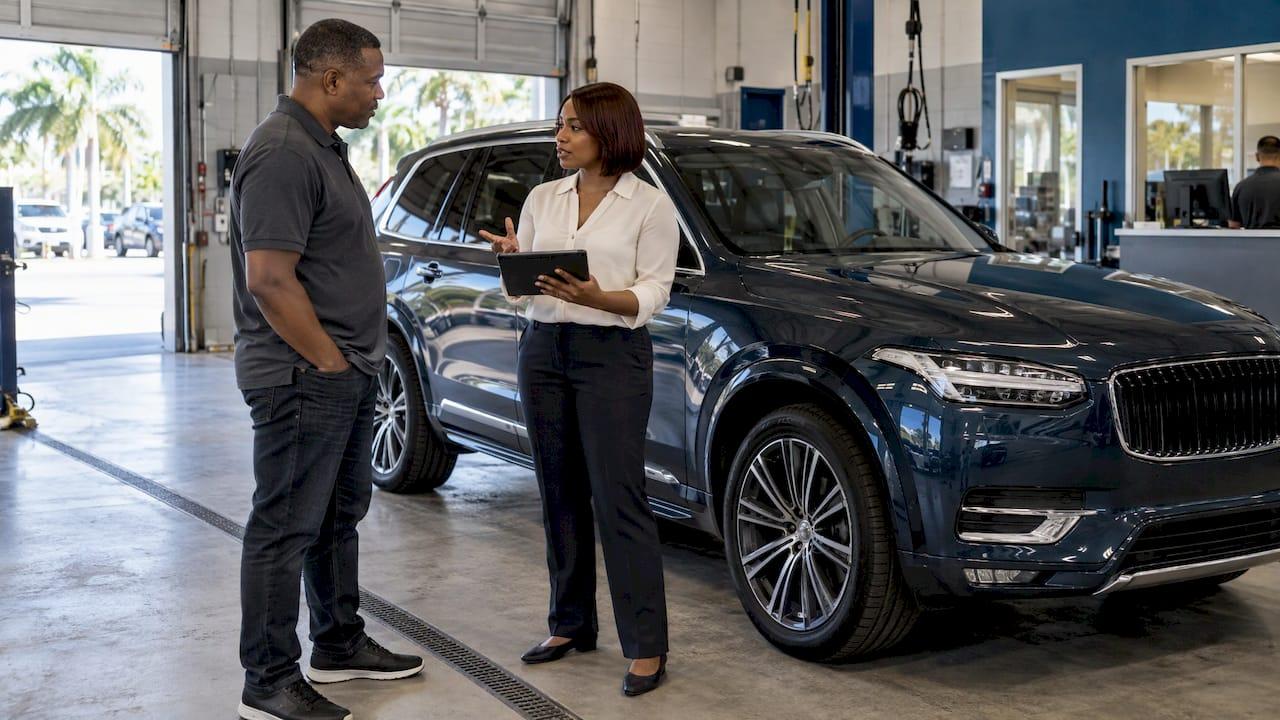
Post-sale support is everything a dealership does for you after you sign: follow-up on how the car is running, help with warranty questions, service reminders, recall guidance and a real person to call when something comes up. For a used or luxury car, it matters as much as the price, because that is where the relationship either continues or ends. The best way to judge it is to ask for specifics before you buy, and the sections below show which ones. At Auto Vendors Inc in Fort Lauderdale, the personalized, hands-on approach that helps you find the right vehicle is built on the same idea: a purchase is the start of a relationship, not the end of one.
TL;DR
- Good post-sale support is a schedule, not a feeling: a thank-you and check-in in the first days, an issue-resolution call in the first week or two, and a first-service reminder within weeks.
- On a used car, the FTC's Buyers Guide on the window states whether the car is sold as-is or with a warranty, and it names the dealer's contact for complaints after the sale.
- Manufacturer warranties come with the car. Extended warranties and service contracts are optional add-ons, and some require dealer service.
- Before you sign, meet the service manager, ask about service intervals and leave with every document: contract, title, registration, warranty papers and receipts.
- Check for open recalls by VIN. Federal law does not require a dealer to fix recalls on used cars.
Table of Contents
- What post-sale support actually includes
- Who needs this most
- Start with the Buyers Guide
- Warranty, service contract or neither: know the difference
- A first-year support timeline you can use
- Recalls: a step you own
- When something goes wrong: the escalation path
- Questions to ask before you buy
- Paperwork is part of support
- Keeping the car at its best between visits
- Our perspective
- Start with a dealership built around you
- FAQ
- Sources
What post-sale support actually includes
Most buyers picture a warranty. In practice, support has three layers: the communication a dealership offers, the coverage that comes with the car, and the service the dealership provides over the years.
Communication. A published follow-up timeline from a dealership-software company lays out a typical sequence: a thank-you within 2 to 3 hours of delivery, a day-3 reminder about features and a satisfaction check, a day-7 phone call to resolve any issues, a day-30 first-service reminder with a review request, a day-90 satisfaction survey, and monthly or quarterly touchpoints through month 12 (Rework's post-sale follow-up guide). A second dealership-software guide describes a satisfaction check three days after delivery, a first-service welcome 45 to 60 days after delivery based on the manufacturer's recommended intervals, and accessory reminders three to nine months out (Tekion's retention guide). Treat these as a picture of what well-run follow-up looks like. The exact timing matters less than whether a dealership has any routine at all.

Coverage. This is what travels with the car: a manufacturer's warranty if time or mileage remain, a dealer warranty if the Buyers Guide says so, and any service contract you chose to buy.
Service. Trade association NADA notes that a salesperson selling 10 cars a month may personally deal with up to 50 customers or prospects, while one service adviser deals with ten times as many people in the same period. It calls service the face of the dealership (NADA). Your day-to-day experience of a dealership will often be a service lane, not a showroom.
Who needs this most
Every buyer benefits, but the stakes differ.
- First-time luxury buyers are usually stretching a budget and want no surprises. Clear warranty terms and a known service contact protect that budget.
- Busy professionals value a single point of contact who can handle paperwork, scheduling and questions without a string of phone calls. Our piece on time-saving dealership services covers what that looks like.
- Families buying SUVs and minivans drive many miles, so maintenance intervals and recalls come up sooner.
- Enthusiasts and luxury buyers often choose cars with complex electronics, where who services the car and what the warranty covers deserve a closer look.
Start with the Buyers Guide
For a used car, the most important post-sale document is posted before you buy. The FTC's Used Car Rule requires dealers to display a Buyers Guide on every used vehicle. It states whether the car is sold as-is or with a warranty, what percentage of repair costs the dealer pays, and the dealer's contact information, including a complaints contact. The guide becomes part of the sales contract and overrides contrary contract language (FTC, Buying a Used Car).
NADA's compliance guide adds that the guide must list the name, email and telephone number of the person to contact if a complaint arises after the sale. A dealer offering a warranty must provide a written document stating coverage, duration, how to get warranty service and who to contact for it (NADA, Driven guide).
In plain terms: read the Buyers Guide before you talk numbers, and photograph it or take a copy. It tells you who answers for the car after you leave.
Warranty, service contract or neither: know the difference
The Consumer Financial Protection Bureau explains that a manufacturer's warranty is included with purchase and generally covers defects for a set time or mileage, but not routine maintenance. Extended warranties and service contracts are optional add-ons. Service contracts may cover maintenance and may require you to return to the dealer for service, and add-on products can be canceled at any time (CFPB).
Two more points from the FTC are worth knowing:
- If you buy a service contract from the dealer within 90 days of buying a used vehicle, federal law prohibits the dealer from eliminating implied warranties on the systems the contract covers (FTC, Buying a Used Car).
- Routine maintenance such as oil changes, tire rotations, brake pads and inspections does not have to be done at a dealer to keep a warranty valid, but you should keep a file of every repair and service record in case you need to file a claim (FTC, Auto Warranties, Routine Maintenance, and Repairs).
That record file matters more with premium models. If you are comparing luxury warranties, our guide to used luxury warranties that cover electronics and ADAS explains what to look for in the coverage list. And when you review a car's history, five steps to verify service records shows how to read what the previous owner documented.
A first-year support timeline you can use
Use this as your own checklist. It combines the follow-up sequences above with the practical steps the FTC and dealer associations recommend.
| When | What should happen | What you do |
|---|---|---|
| Delivery day | Thank-you and handoff of documents | Confirm you have the contract, title paperwork, registration, owner's manual, warranty papers and receipts |
| Days 1 to 3 | Satisfaction check by phone, text or email | Report anything odd: warning lights, noises, features you cannot figure out |
| Day 7 | Issue-resolution call | Raise any open item in writing as well |
| Days 30 to 60 | First-service reminder based on the manufacturer's interval | Book the visit and keep the receipt |
| Day 90 | Satisfaction survey | Give honest feedback |
| Months 4 to 12 | Periodic check-ins and service reminders | Add every service record to your file |
The intervals come from the follow-up guides cited earlier. Your owner's manual sets the actual service schedule for your car, and the manual should win any disagreement.
Recalls: a step you own
Recalls surprise used-car buyers more than anything else. The FTC advises checking for unrepaired recalls by asking the dealer or entering the VIN (vehicle identification number, the 17-character code on the dashboard and door jamb) at the federal recall lookup, or by calling NHTSA at 1-888-327-4236. It also notes that federal law does not require dealers to fix recalls on used cars, so you may need to arrange the repair yourself (FTC, Buying a Used Car).
Run the VIN before you sign and again at the one-year mark, since new recalls are issued over time. Ask the dealer what the car's recall status is and have the answer in writing. Manufacturer-authorized dealers perform recall repairs for their own brand, so the maker's authorized network is where open items get fixed.
When something goes wrong: the escalation path
The FTC's advice is to start with the dealer: talk to the salesperson or the owner. If the warranty is manufacturer-backed, you can contact the local or zone manufacturer representative, who is authorized to decide warranty service issues (FTC, Buying a Used Car).
Manufacturers publish their own ladders. Chrysler's 2025 US warranty manual, for example, directs owners to the authorized dealer's service or sales manager first, then the dealer's owner or general manager, then the company's Customer Assistance Center, with an arbitration process available by phone (2025 Chrysler warranty manual). The same manual recommends returning to the authorized dealer you bought from for maintenance, while noting that warranty service can be obtained from any authorized dealer of that make.
A practical way to use all this: write down dates, mileage and what each person told you. A clear paper trail shortens every step of any escalation.

Questions to ask before you buy
The Washington State Automobile Dealers Association advises buyers to meet the service department manager or a service advisor before driving off, ask about recommended service intervals, and leave with copies of the finance or lease contract, title, registration, owner's manual, car, tire and battery warranties, payment receipts and any extended service contract. It also warns that ignoring factory service guidelines can give a service department grounds to reject a warranty claim (WSADA).
Turn that into a short list you can bring to the dealership:
- Who is my contact after the sale, by name, phone and email?
- Does the Buyers Guide say as-is or warranty, and what exactly is covered?
- How will you follow up in the first week, and how will I hear about my first service?
- What happens if I find a problem in the first 30 days?
- Can you show me the recall status and the service records you have for this VIN?
- If I trade in later, how is my car valued, and can financing be arranged in the same place?
For a fuller framework, see how to evaluate dealer personalized service, and the pre-owned luxury inspection checklist for what to check on the car itself before you sign. Buying remotely? Our three steps for buying sight unseen matter even more, since you cannot walk into a service lane to meet someone first.
Paperwork is part of support
A dealer that handles title and registration cleanly spares you weeks of frustration at the DMV. Collect every document at delivery and confirm the title and registration timeline in writing. Our guide to used car paperwork and red flags walks through what a complete file looks like. Dealerships also charge a documentation fee for processing this work. Ask for it as a line item before you commit, so the out-the-door price has no surprises.
Keeping the car at its best between visits
Support does not stop at service intervals. Many owners keep a luxury finish looking new with regular washing and protection between visits. Ceramic-infused car care products from Diamondbrite cover cleaning, glazes and surface protection, and they fit neatly alongside a service-reminder routine: when the first-service notice arrives, it is a good moment to refresh the wash-and-protect schedule too.
Our perspective
Every buyer who walks into our Fort Lauderdale showroom is making a long-term decision. A premium vehicle is an investment, and the work we do to find the right one, whether that is a specific luxury model, a family SUV or something unusual, only pays off if the ownership experience matches the first impression.
That is why we see personalized service as the core of the business rather than an extra. Helping you find the car, valuing your trade-in and arranging financing in one place are all ways of saying the same thing: we want to know you, and we want you to come back. Our long experience in the automotive market has taught us that loyalty is earned by being reachable and clear long after the sale.
Our advice is simple. Choose a dealership that can tell you, in plain words, who to call and what happens next. If you want to see how we think about this, our articles on dealership relationship managers and loyalty programs that benefit buyers explain what a good ongoing relationship looks like.
Allen
Start with a dealership built around you
Auto Vendors Inc sells used vehicles with a focus on luxury and premium models, and you can search inventory by make, model, body style and price. If you do not see what you want, our Car Finder service provides personalized vehicle-finding assistance. Trade-in valuation and financing options are part of what we offer, so the major steps of a purchase can be handled with one team.
Browse used cars for sale, look at SUVs for the family, or tell us what you are after through the Car Finder.
When you contact us, bring the questions from the list above. They are the right ones to ask any dealership.
FAQ
What are after-sale services at a dealership?
They include follow-up contact after delivery, help with warranty questions, service and maintenance scheduling, recall guidance and assistance with paperwork. Some, such as a manufacturer's warranty, come with the car, while extended warranties and service contracts are optional add-ons (CFPB).
Do I have to service my car at the dealership to keep the warranty?
Not for routine maintenance. The FTC says oil changes, tire rotations, brake pads and inspections do not have to be done at the dealer to keep a warranty valid, but you should keep records of all work (FTC). A service contract is different, since it may require dealer service, so read its terms.
Is a dealer required to fix recalls on a used car?
No. According to the FTC, federal law does not require dealers to fix recalls on used cars, so you may need to arrange the repair. Check the VIN before buying and ask the dealer for the recall status in writing.
Who do I contact after buying a used car if there is a problem?
The Buyers Guide lists the dealer's contact person for complaints after the sale. Start there, then escalate to the owner and, for manufacturer-backed warranties, to the manufacturer's representative, as the FTC advises.
Sources
- Rework: Post-sale follow-up process
- Tekion: Retention is revenue after the sale
- NADA: Why service is the largest single influence on the public's perception of your dealership
- FTC: Buying a Used Car
- NADA: Driven compliance guide
- CFPB: Manufacturer's warranty vs. extended warranty or service contract
- FTC: Auto Warranties, Routine Maintenance, and Repairs
- FCA US LLC: 2025 Chrysler warranty manual
- WSADA: Buying a Car guide