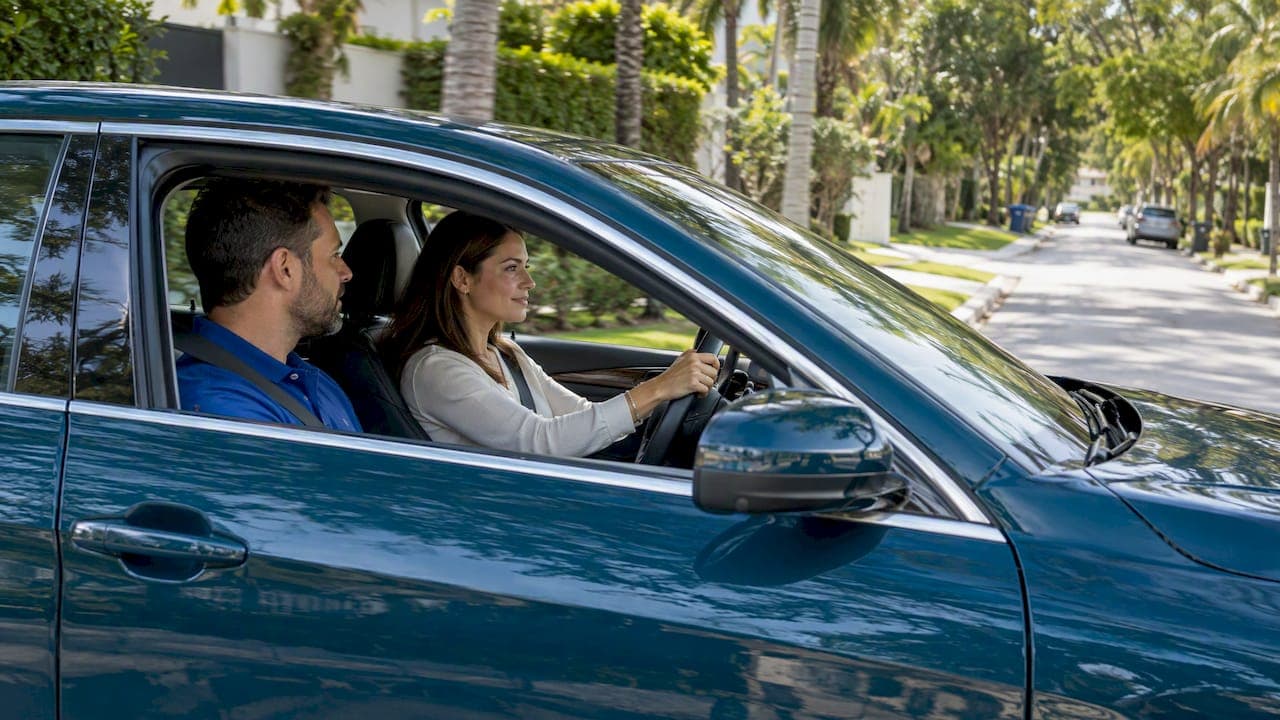
Good test drive etiquette comes down to four habits: show up prepared, treat the car and the salesperson's time with respect, drive a route that tests the things you care about, and be honest when you leave about where you stand. Do those and you will get a better drive, more useful answers and a calmer buying decision. This guide covers each step, with extra attention to used and luxury vehicles, where the drive is also your first inspection.
TL;DR
- Book ahead, bring your driver's license, and tell the dealership which car and which trim you want to drive.
- Plan your own route with city streets, a highway stretch and rough pavement, and aim for at least 30 minutes if you can.
- Turn the radio off, keep conversation short, and bring a friend to handle small talk if that helps you focus.
- On a used car, the drive is not the inspection: ask for service records and a vehicle history, and have an independent mechanic look at it before you buy.
- Afterward, thank the salesperson, say plainly what your next step is, and take notes while the drive is fresh.
Table of Contents
- Why etiquette matters on a test drive
- Before you go: prepare like a buyer
- At the dealership: how to behave
- On the road: a route that tells you something
- Test driving a used car: etiquette plus due diligence
- A lesson from boats: the longer trial wins
- Our perspective: what we see on the lot
- After the drive: how to wrap up well
- Quick etiquette dos and don'ts
- Find your next car with us
- FAQ
- Sources
Why etiquette matters on a test drive
A test drive is a short, unusual arrangement. A dealership hands the keys of a high-value vehicle to a stranger, and the stranger gets a chance to make a five-figure or six-figure decision based on a few miles. Both sides do better when expectations are clear.
For you, good manners are practical. A salesperson who feels respected is more likely to let you take the longer route, answer awkward questions about the car's history and give you room to think. For the dealership, a buyer who arrives with a plan makes the drive useful rather than a formality.
None of this is about being stiff. It is about being clear, on time and considerate, and about not letting politeness stop you from testing the car properly. You are allowed to ask for a longer drive, to say no to a pitch, and to leave without buying.
Before you go: prepare like a buyer
Book an appointment
Calling or booking ahead is courteous and it works in your favor. The car will be cleaned, fueled, parked where it can be reached easily and, ideally, the right person will be free to go with you. Some dealerships work by appointment only for certain vehicles. If you are curious how that works in practice, our guide to appointment-only test drives explains how to book and what to expect.
When you book, say which vehicle you want, and mention the route you would like to drive. Mazda's guide recommends telling the dealership your preferred route when you make the appointment, and suggests 10 to 20 miles as an absolute minimum for it.
Bring the right things
Keep the list short:
- Your driver's license. You cannot drive without it, and the dealership will copy it.
- Proof of insurance, if you have it. A dealership may ask for it, but you generally do not need your own policy to test-drive, because the dealership carries coverage on its vehicles. You can still be responsible for damage beyond their limits, so it is worth knowing your own situation.
- Things you actually use. Mazda suggests bringing child seats or booster seats and the cargo you regularly carry, such as strollers or golf clubs, so you can see whether they fit. Families shopping for an SUV or minivan should take this seriously: installing a car seat in a showroom tells you more than any brochure.
- A notes app or a pen. You will forget details within an hour.
Know what you are comparing against
Consumer Reports advises writing down what you like and dislike about your current car, so you do not overlook those issues in the new one. If your current car has a seat that hurts your back on long trips, you want that on your list before you sit down in the new one.
The same source recommends driving the exact configuration you intend to buy. A fully loaded version with a different engine or suspension can give an unrealistic impression of a base or mid-level trim. With a used car this is simpler, since the car you drive is the car you would own, but it is still worth confirming that the specific vehicle matches the listing.
Plan the day, not just the drive
Test driving is tiring. Mazda notes that it can be physically and mentally taxing, and recommends spacing visits out, even over several days, so you do not rush the decision. If you are comparing two or three vehicles, Consumer Reports suggests scheduling the drives back to back so the differences are fresh in your mind. Those two ideas work together: do the comparison drives in one block, then sleep on it before you commit.
At the dealership: how to behave
Arrive on time and be direct
Arrive a few minutes early. If you are running late, call. The salesperson has likely blocked time for you and may have other buyers waiting.
Introduce yourself, say which car you came for, and say honestly where you are in the process: researching, comparing or ready to buy within the month. You do not owe anyone your budget or your trade-in value on the first meeting, but vague signals waste both your time. "I'm comparing this with one other car and want to decide this week" is clear and fair.
Handle the salesperson's questions gracefully
Expect questions about what you drive now, what you are looking for and how you plan to pay. Answer what you are comfortable with and decline the rest politely. "I'd like to focus on the car today and talk numbers after the drive" is a perfectly normal thing to say.
If you are easily pulled into conversation, bring someone along. Consumer Reports suggests bringing a friend who can handle small talk with the salesperson while you concentrate on the vehicle. That person can also be a second pair of ears for noises and a second opinion on comfort.
Treat the car as if it were already yours
The basic courtesies are simple:
- Do not eat or drink in the car, and keep your shoes clean.
- Do not leave anything behind and do not rummage through personal items from the previous owner or the glove box beyond what is relevant.
- Adjust seats and mirrors before you move, and put them back if the salesperson is going to drive the car afterward.
- Do not push a car you do not own to its limits. You can evaluate acceleration with a firm, legal merge onto a highway. You do not need to find out what the tires do on a wet corner.
- Obey every traffic law. Your test drive is subject to the same rules as any drive, and a ticket helps no one.
Walk around before you drive
Before you pull out, spend five minutes with the car stationary. Look at the tires for even wear, check the body panels for uneven gaps or mismatched paint, and sit in each seat. Open and close the doors and trunk, test the windows and sunroof, and connect your phone to the infotainment system. On a luxury vehicle, spend a moment with the digital displays and driver assistance settings, since these are often where owners find frustrations later. If the salesperson walks you through features, let them: it is part of the service, and a good one will know the car well.

For luxury and premium models, we have a more detailed walkthrough in our luxury SUV test drive checklist, and it is useful for sedans and coupes too.
On the road: a route that tells you something
The worst test drive is a quick loop around the block that the salesperson chose. The best is one you planned. Consumer Reports advises planning your own route over city and highway roads and varied surfaces, such as speed bumps or a rutted parking lot, driving for at least 30 minutes if possible and turning off the radio so you can listen to the car.
Here is a simple structure for that time:
| Segment | What to do | What it tells you |
|---|---|---|
| Parking lot | Turn the wheel lock to lock, reverse, park | Turning circle, visibility, camera and sensor quality |
| Stop-and-go streets | Brake gently and firmly (when safe), accelerate from a stop | Brake feel, low-speed transmission behavior, throttle response |
| Rough pavement | Cross a speed bump or uneven stretch slowly | Suspension noises, rattles, ride comfort |
| Highway | Merge, hold 60 to 70 mph where legal, change lanes | Passing power, wind and road noise, stability, driver assistance |
| Quiet stretch | Radio off, windows up, then down | Squeaks, humming, knocks, whines |
Ask before you detour
If your route differs from what the dealership expects, say so when you leave: "I'd like to take about 30 minutes and include some highway." Most dealerships are happy to accommodate, especially if you booked ahead. If a salesperson is in the car with you, keep the conversation light and let them know when you need quiet. Saying "I'm going to concentrate on how it sounds for a few minutes" is not rude. It is what the drive is for.
Let the car be the focus
Turn off the radio, as noted above, and resist the urge to play your own music for the first half of the drive. Once you have listened for noises, then test the audio system. Notice seating position, sight lines over your shoulder, how easy it is to enter and exit, and whether controls are where you would reach for them. Pay attention to how you feel after 30 minutes: tired, tense or comfortable.
Test driving a used car: etiquette plus due diligence
The keyword question people ask most often is how to test drive a used car, and the honest answer is that the drive is only part of the process. A used car has history that a short drive cannot reveal.
The Federal Trade Commission's used car guidance recommends that you ask for maintenance records, check for unrepaired recalls, review the vehicle's history and have an independent mechanic inspect it before you buy. The same guide distinguishes between a mechanical inspection, which gives a general indication of mechanical condition, and a safety inspection, which focuses on conditions that make a vehicle unsafe to drive.
In practice, that means:
- Ask for the paperwork before or right after the drive. A seller who is proud of a car's history will have records ready. Our guide to verifying service records shows what to look for.
- Review the vehicle history report. Make sure the report matches the car in front of you. See how to verify a luxury vehicle history report.
- Ask permission for an independent inspection. It is a normal request. A dealer that says no deserves your suspicion. Read why pre-inspection matters on used luxury cars.
- Note anything you want checked. If you heard a click on turns or felt a shudder at 45 mph, write down the speed and conditions so the mechanic can look for it.
For higher-end vehicles, our pre-owned luxury car inspection checklist and guide on how to inspect a pre-owned luxury vehicle go through the details system by system. If the car is rare or low-production, see how to evaluate a rare car's mechanical condition.
What a test drive cannot tell you
A 30-minute drive will not reveal a slowly leaking gasket, an intermittent electrical fault or a transmission that only misbehaves when fully warm after an hour. That is why records and an inspection matter. Treat the drive as a way to rule cars out and to learn what you like, and treat the inspection as the way to rule one in.
It is also worth asking whether a car has been used as a dealer demo or loaner, since that affects mileage and wear. Our explainer on the dealer demo vehicle meaning covers what that label should and should not tell you.
A lesson from boats: the longer trial wins
The principle that a longer, structured trial reveals more is not limited to cars. Anyone considering a large purchase with moving parts benefits from time under real operating conditions, which is why a sea trial for pre-owned yachts typically runs for hours rather than minutes. For cars, you rarely get hours, but you can push the drive toward 30 minutes or more, and for a serious contender you can ask for more time still.
Our perspective: what we see on the lot
At Auto Vendors Inc in Fort Lauderdale, we work with buyers who are comparing premium used vehicles, and we see the same pattern again and again. The buyers who feel best about their purchase are not the ones who drove the longest or asked the cleverest question. They are the ones who knew what they wanted from the car and told us so.
Our approach is personal. We would rather learn what your week looks like, whether it is school runs, client meetings or weekend drives, and then find a car that fits, than push whichever vehicle is closest to the door. That is why we offer personalized vehicle finding assistance, and why we are comfortable with buyers who want a second drive, a longer route or an independent inspection. A premium car should stand up to scrutiny, and our job is to help you carry it out comfortably.
If you take one thing from this guide, make it this: tell the salesperson what you need to test. We would rather hear "I need to check how my two car seats fit" or "I want to take this on the highway" than watch you leave with unanswered questions. A good dealership treats those requests as part of the job.
— Allen
After the drive: how to wrap up well
Take notes immediately
Before you start the next appointment or drive home, write down what you noticed: ride, noise, visibility, seat comfort, anything that annoyed you. NerdWallet recommends that you review your notes and compare the cars you drove, and if you have narrowed your choice, ask whether you can take the car home overnight to check its fit and its lighting. Not every dealership offers this, but asking is acceptable, and an overnight stay shows you how the car fits your garage, your driveway and your headlights on a dark road.
Be honest about your next step
You do not have to decide on the spot. A simple, courteous exit sounds like this: "Thank you, this was helpful. I'd like to think it over and I'll let you know by Friday." Then actually let them know. If you have decided against the car, a short message saves the salesperson from chasing you and keeps the door open if you change your mind.
If you are interested, this is the moment to ask about the numbers: the out-the-door price, the dealer documentation fee, financing terms and your trade-in. Asking about fees early is fair and expected.
Resist pressure in both directions
A salesperson may suggest that the car will not last the weekend. Sometimes that is true. Often it is not. Ask what would happen if you came back tomorrow, and weigh the answer calmly. At the same time, avoid the opposite error of dragging a salesperson through a dozen drives when you have no intention to buy. Test driving is free, and that is a privilege worth respecting.
Quick etiquette dos and don'ts
| Do | Don't |
|---|---|
| Book ahead and arrive on time | Show up at closing time without notice |
| Bring your license and the things you carry | Expect to drive without ID |
| Tell the dealer your route and time needs | Take an unannounced detour or leave the area |
| Ask for records and an independent inspection on used cars | Assume a good drive means a good car |
| Give honest feedback and a timeline | Disappear after the drive |
| Keep the cabin clean and obey traffic laws | Eat, smoke or push the car to its limits |
Find your next car with us
If you are shopping for a premium used car in South Florida, we can help you narrow the field before you ever pick up a key. Tell us what you drive now, what you need and what is not working, and our Car Finder service will look for vehicles that match. You can also browse our used inventory by make, model, body style and price, or go straight to our SUVs and sedans.
When you find a car you like, book a drive and tell us what you want to test. We also handle trade-in valuations and financing, so you can compare the whole picture in one visit. To start with a personal search, visit our Car Finder page.
FAQ
How long should a test drive last?
Aim for at least 30 minutes if the dealership allows it, according to Consumer Reports. Mazda suggests a route of 10 to 20 miles as a minimum. Ask for the time when you book, since a short loop is rarely enough to judge highway behavior or comfort.
Do I need my own insurance to test drive a car?
Generally no. A dealership carries coverage on the vehicles it lets customers drive, and Policygenius notes that you can test drive without a policy of your own. You will usually need to show a valid driver's license. Ask the dealership about its requirements when you book.
Is it rude to test drive a car I'm not sure I'll buy?
No. Test drives exist so buyers can decide. It becomes unfair only when you have no intention of buying, or when you take up long stretches of time without saying so. Be honest about where you are in the process and let the salesperson know your decision afterward.
Can I take someone with me on a test drive?
Yes, and it often helps. A friend can handle small talk, listen for noises and give a second opinion on comfort. If you are testing a family vehicle, bring the people and car seats who will ride in it so you can check the fit.
What should I do if I find a problem during the drive?
Mention it calmly to the salesperson and write it down, including the speed and conditions. For a used car, ask for service records and request an independent mechanic's inspection before you buy, as the FTC advises. Do not assume a small noise is harmless, and do not assume it is a dealbreaker until it is checked.
Sources
- How to Test-Drive a Car - Complete Guide, Mazda USA
- How to Test-Drive a New or Used Car, Consumer Reports
- Buying a Used Car, Federal Trade Commission
- How to Make the Most of a Test Drive, NerdWallet
- Do You Need Insurance to Test-Drive a Car?, Policygenius