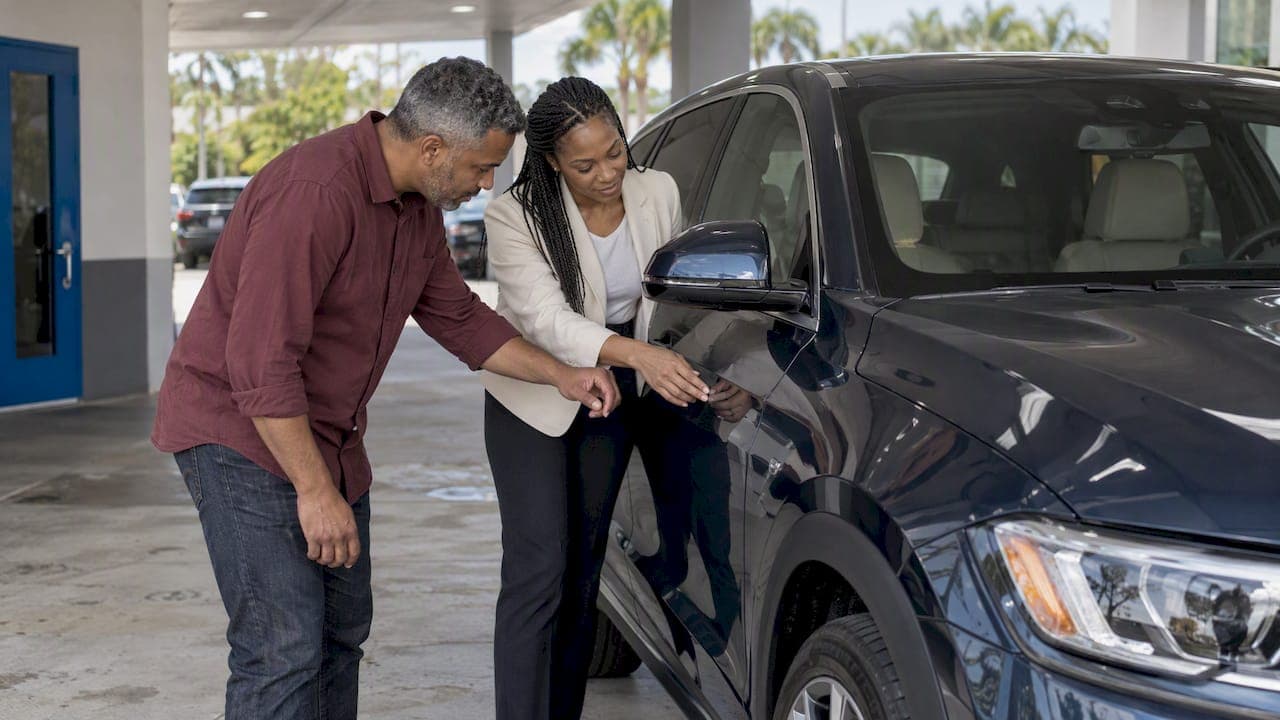
A curated car dealership chooses its inventory car by car instead of taking whatever the auction lane offers. It usually runs smaller, with fewer vehicles, more attention per vehicle and more conversation with the buyer. "Curated" is a marketing word with no legal definition, though, so the real test is what the dealer does before a car reaches the lot and what it will show you in writing. This guide covers both: how to recognize a dealership that earns the label, and how to check one before you pay.
TL;DR
- A curated or boutique dealership is defined by selection, size and service, not by a regulated standard. Judge it by its process and its paperwork.
- Ask how each car was chosen, inspected and verified, then confirm it yourself with a vehicle-history report, a recall check and an independent mechanic.
- Every dealer must display an FTC Buyers Guide on a used car. It tells you whether the car is sold as-is or with a warranty, so read it before you talk price.
- Budget for the whole cost of owning a luxury car: registration, insurance, fuel, maintenance and financing, not only the sticker price.
- If the car you want is not on the lot, a good curated dealer will search for it with you. We do this through our Car Finder service.
Table of Contents
- What "curated" really means at a car dealership
- Curated versus traditional: where the differences show up
- How a curated dealer should select and check its cars
- What to verify before you buy, step by step
- Personalized help: when the car you want is not on the lot
- Estimating what a luxury car really costs to own
- Choosing a luxury SUV or minivan for a family
- Sought-after cars: how to judge the claims
- Our perspective: what we think a curated dealership owes you
- See what we have, or tell us what you want
- FAQ
- Sources
What "curated" really means at a car dealership
In most retail categories, curating means someone with taste and expertise decides what is worth stocking and what is not. At a car dealership, that translates into a few concrete things:
- A focused range. Instead of hundreds of unrelated trade-ins, you see a tighter group of vehicles chosen for condition, reputation and appeal.
- A buying standard. Cars are rejected before purchase for history, wear or mechanical problems, so the lot reflects what was turned down as much as what was kept.
- Hands-on service. Staff know the cars personally and can tell you why each one is there.
- A relationship, not just a transaction. The dealer expects you to come back, or to send a friend.
The word "boutique" points at the same idea from a different angle. An industry article in Auto Dealer Today describes the boutique dealership as a smaller, less conventional retail format that puts the showroom experience and customer engagement ahead of the layout of a traditional store. That smaller scale is the point: fewer cars means more time to explain each one, and a lot of the sale happens through conversation rather than through a sales floor built for volume. The same thinking shows up in other enthusiast corners of the car world, where details like bespoke lighting concepts are part of what makes a vehicle feel individual.
Notice what the definition leaves out. Neither word guarantees that a car is accident-free, well maintained or fairly priced. Those things are proven by documents and inspections, which is why the rest of this guide is about verification.
Curated versus traditional: where the differences show up
The contrast is easiest to see in how the two models work day to day. These are general patterns, not rules, and any individual dealership can break them.
| Traditional high-volume lot | Curated or boutique dealership | |
|---|---|---|
| Inventory | Broad, often hundreds of vehicles across many price tiers | Narrower, chosen for quality and appeal |
| Buying approach | Volume-driven acquisition | Selective, car by car |
| Staff role | Often process-driven | Typically product knowledge and advice |
| Special requests | Usually limited to what is in stock | Often includes searching for a specific vehicle |
| Your job as a buyer | Verify everything | Verify everything |
The last row matters most. A better experience is not a substitute for a better inspection. The best curated dealers welcome verification because their cars hold up to it.
How a curated dealer should select and check its cars
You should be able to ask a dealer how a car got onto its lot and get a specific answer. Vague talk of "hand-picked quality" is a prompt to ask more questions.
What a solid selection process looks like, in practice:
- History screening before purchase. Title status, accident and total-loss records, odometer consistency and open recalls all come first. A car with a troubled history should be turned down before any money is spent on reconditioning.
- A physical inspection. A technician or buyer goes over mechanical systems, brakes, tires, electrical and safety features and the cosmetics, then road-tests the car.
- Repair of what was found. Problems are fixed or the car is declined, and the findings are documented.
- A second look. A manager or another person reviews the result, so one person's judgment is not the only check.
The federal government publishes what a rigorous version of this looks like in one specific program. Certified pre-owned inspection requirements from one automaker, posted by NHTSA, call for matching VIN plates, a clean-title report, an open-recall check and inspection for non-original parts. Performance modifications or title problems disqualify the vehicle. You do not need a factory program to hold a dealer to the same ideas: ask whether the VINs match, whether the title is clean, whether recalls are closed and whether the car has been modified.
We go deeper on this in our guide to how curated dealership selection works for buyers, and our pre-owned luxury car inspection checklist gives you something to carry to the lot.
What to verify before you buy, step by step
Whether the dealership is boutique or enormous, the buyer's protections are the same, and so is the homework. The FTC's guidance on buying a used car from a dealer boils it down to reviewing the Buyers Guide, getting a vehicle-history report, checking for recalls and arranging an independent inspection. Here is how to apply that to a luxury purchase.

Read the Buyers Guide first
The FTC says dealers must display a Buyers Guide on every used car offered for sale and hand it to you after the sale. It states whether the car is sold as-is or with a warranty, lists major systems and common problems, and, when there is a warranty, says what share of repair costs the dealer will pay. The Guide is part of your contract, so if a salesperson promises something that is not on it, get that promise in writing. The FTC is direct on this point: written promises are the ones you can rely on.
Pull a vehicle-history report and check what it actually says
A history report is a starting point, not a verdict. Read it for title brands, reported accidents, odometer readings over time and the number of owners. Then compare it to the car in front of you. Our guide to verifying a luxury vehicle history report walks through the details, and our five-step method for verifying service records shows how to confirm that the maintenance a seller claims really happened.
Check for flood and title problems
This matters especially in a coastal state. NHTSA warns that flood-damaged vehicles can look perfectly normal and develop problems later. It recommends checking the title history through NMVTIS and looking for a musty odor, waterlines or dirt in hidden areas, and unusual rust or corrosion. The agency also explains that a totaled vehicle may receive a salvage or flood title, while a rebuilt vehicle can legally be resold if the defect is disclosed and the title is branded accordingly. Ask directly whether any branded title is involved, and look at the title yourself.

Look at crash, air bag and repair history
NHTSA advises reviewing a used vehicle's history for air-bag deployment, crashes or total-loss events, theft, and repairs done by non-certified facilities. Where that history exists, it recommends an inspection by a certified manufacturer-dealer technician or a reputable independent mechanic. For a luxury car with many electronic safety systems, that advice is worth following even when the history is only partly known.
Pay for an independent inspection
The FTC suggests having your own mechanic inspect the car and asking for a written report with repair estimates. A dealer confident in its cars will not mind. Our article on why pre-inspection matters when buying used luxury cars explains what a good inspection can find that a test drive cannot, and our walkthrough on how to inspect a pre-owned luxury vehicle covers what to look at yourself first.
Personalized help: when the car you want is not on the lot
One of the real advantages of a smaller dealership is that the inventory is not the limit. If you want a particular make, model, color or specification, a dealer with a personal approach can look for it for you.
What that service should include, whoever provides it:
- A conversation about what you actually need: budget, body style, how you will use the car and which features you will not compromise on.
- A search beyond the current lot, with candidate vehicles identified by VIN so each one can be checked before you commit.
- The same verification you would demand of a car on the lot: history report, service records, inspection.
- Clear communication about what a vehicle costs, including fees.
Our Car Finder works this way. You tell us what you are looking for and we help you find it. If you want to see how the process runs, read our three-step custom vehicle search for luxury buyers that verifies VINs. For rare or unusual cars, our guide to evaluating a rare car's mechanical condition explains why condition matters more than rarity, since an uncommon car can be costly to repair when parts and specialists are scarce.
If the vehicle is far away, the stakes rise. Our piece on buying a car sight unseen lists three steps you should never skip, and our guide to used car paperwork shows how to avoid delays at the DMV afterward.
Estimating what a luxury car really costs to own
First-time luxury buyers often shop by monthly payment alone. That works until the first insurance quote or the first service bill. The FTC's advice is to begin with your budget and include registration, insurance, gas, maintenance and financing costs, then compare the total financed price rather than just the payment, and review repair costs and warranty coverage.
A practical way to do that:
- Set a ceiling for the total monthly cost, not only the loan payment. Include insurance, fuel and a maintenance reserve.
- Get insurance quotes on specific cars before you fall for one. Luxury models can vary widely.
- Compare financing offers as a total, looking at the full amount you will pay over the term.
- Read the warranty terms on the Buyers Guide and ask what is covered if something fails after the sale.
- Ask about every fee up front. A dealer documentation fee, often called a doc fee, is one example. Ask for the amount in writing before you negotiate, so you compare cars on the out-the-door price.
If you are trading in a car, a trade-in valuation is part of the same math, because it changes what you need to finance. We include trade-in valuation and financing options in our process, so you can see the numbers together.
Choosing a luxury SUV or minivan for a family
Families are a big share of the people who shop a curated lot, and they should shop differently from enthusiasts. The things to weigh:
- Condition of the safety systems. Look at the history for air-bag deployment or collision repairs, and confirm recalls are closed.
- Use wear. Family vehicles take hard use. Check seat upholstery, sliding doors and tailgates, and rear-seat controls.
- Interior practicality. Third-row access, cargo room and child-seat anchors matter more than a badge.
- Running costs. Larger luxury SUVs can mean higher fuel, tire and insurance costs than a sedan.
- Service history. A documented record is worth more than low mileage with no paperwork.
You can browse our current SUVs for sale in Fort Lauderdale and our full used inventory, which also includes minivans, pickups, sedans and coupes.
Sought-after cars: how to judge the claims
Sellers love to say a car is "collectible" or "rare." Those words describe the story, not the condition. To judge a claim:
- Ask what specifically makes the model desirable: limited production, a particular engine or transmission, a notable design or a strong reputation among enthusiasts.
- Confirm the car matches that story. Matching VIN plates, original parts and documented history carry far more weight than the claim does.
- Treat modifications and gaps in the record as value questions, not just cosmetic ones.
- Have a specialist inspect the car. A general mechanic may miss what matters on an unusual model.
Desirability can change with taste, so no dealer should promise that a car will go up in value. Buy it because you will enjoy driving it and because the car checks out.
Our perspective: what we think a curated dealership owes you
We believe "curated" should be a promise about process. At Auto Vendors Inc in Fort Lauderdale, we focus on a premium selection of quality vehicles, especially luxury models, and we care about the craftsmanship and the elegance of the cars we choose to offer. We think a dealership earns that description by being helpful and open, not by using a nice word.
That is why we encourage buyers to verify. Ask for the history report. Ask for the service records. Bring your own mechanic. A buyer who has checked a car and still wants it is a buyer who will be happy a year from now, and that is the relationship we want. For busy professionals who do not have time to search, and for first-time luxury buyers who are unsure what to look for, we offer hands-on help finding the right vehicle, not just a lot to walk.
A small dealership cannot compete on volume. We compete on knowing our cars and the people who buy them.
— Allen
See what we have, or tell us what you want
If you are ready to look, start with our cars for sale in Fort Lauderdale. You can search by make, model, body style and price. If you do not see the right car, use our Car Finder and tell us what you want. We will help you find it, and we will show you how it checks out before you decide.
FAQ
Is a boutique car dealership the same as a curated one?
In everyday use, yes. Both terms describe a smaller dealership with a selective inventory and more personal service. Neither is a legal category, so judge a dealer by how it selects and documents its cars.
Are curated dealership cars more expensive?
Not necessarily, and a dealer's label says nothing about price. Compare any car on its out-the-door price, including fees, and against its condition, history and warranty terms. Ask for the full price in writing.
Do I still need an independent inspection at a curated dealership?
Yes. The FTC recommends having your own mechanic inspect a used car and asking for a written report with repair estimates. A good dealer will let you do this, and the result gives you a neutral view of the car.
What is the Buyers Guide on a used car?
It is a form dealers must display on every used car they offer, and give to you after the sale. It says whether the car is sold as-is or with a warranty and lists major systems and common problems. If the dealer promises anything beyond it, get that in writing.
Can a dealership find a specific luxury car for me?
Many can. At Auto Vendors Inc, our Car Finder service helps you search for a specific vehicle, and we encourage verifying each candidate's VIN, history and condition before you buy.
Sources
- The Boutique Dealership, Auto Dealer Today
- Buying a Used Car From a Dealer, FTC Consumer Advice
- Hurricane- and Flood-Damaged Vehicles, NHTSA
- Deadly Air Bag Inflator Replacements: What to Know, NHTSA
- Certified pre-owned inspection requirements notice, NHTSA
- Bespoke lighting concepts for car enthusiasts