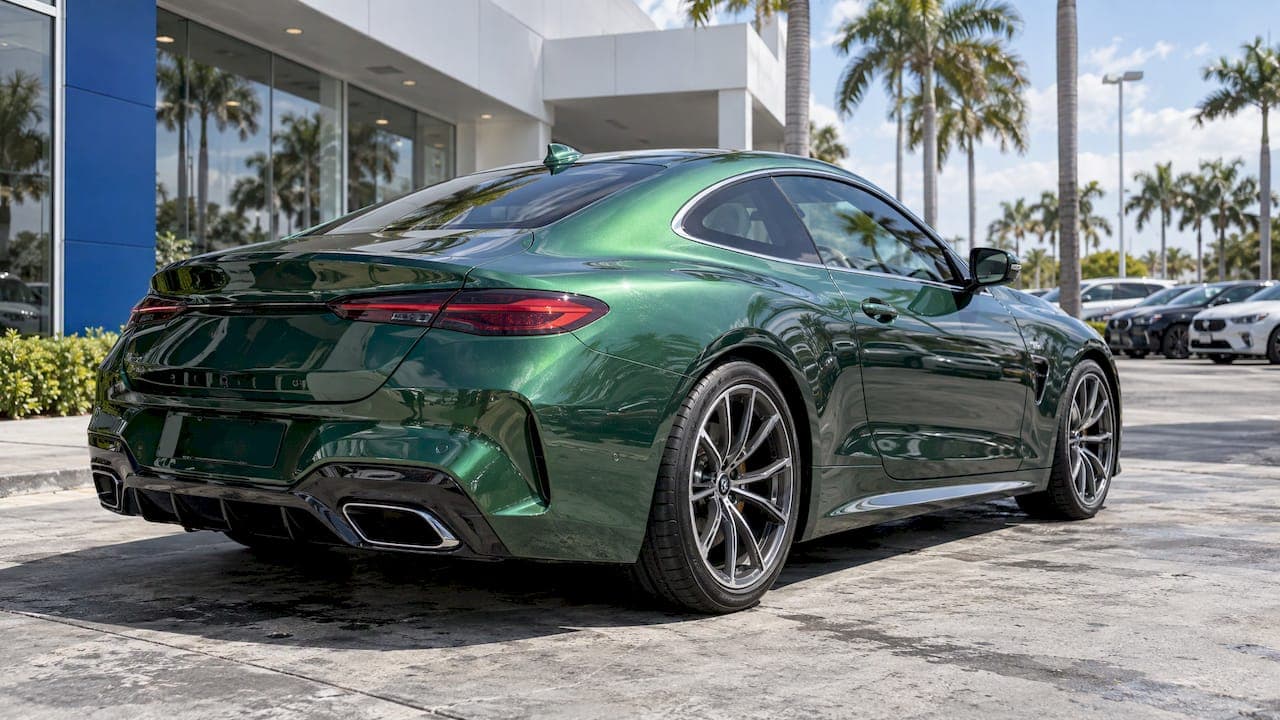
A rare car color is one that very few cars left the factory wearing, because it ran for one model year, was built in tiny numbers, or was a special order. Think Porsche Moonstone, Corvette Tuxedo Black or Ford Orange Fury. Rarity can make a car more interesting and sometimes more valuable, but not automatically. This guide explains how rarity works, which colors are genuinely scarce, what the resale data says, and how to check that the paint on a used car is the one it left the factory with.
TL;DR
- A color is rare because of low production, a short model-year run or special-order status, not because it looks unusual.
- Verified examples include 815 Tuxedo Black Corvettes in 1967 and only 223 Porsches in Moonstone worldwide.
- Resale results are mixed: bright colors like yellow have held value well, but brown has not, and condition usually matters more than color.
- Before buying, confirm the factory paint code, the model year and the paint's originality.
- If you want a specific color, a personalized car search saves months of scrolling listings.
Table of Contents
- What actually makes a car color rare
- Rare factory colors with documented numbers
- Unusual colors that get talked about
- Do rare colors hold their value?
- How to find a used car in an uncommon color
- What to verify before you buy
- Rare colors and collectible cars
- Practical advice for different buyers
- Is any car color illegal?
- Find your color with Auto Vendors
- FAQ
- Sources
What actually makes a car color rare
Rarity has three common sources, and they are worth separating because they affect value differently.
Low production. The factory built few cars in that color, either because the color was unpopular or because the whole car was a limited run. Hot Rod's guide to Corvette C2 colors frames rarity this way, noting that a color can be scarce because it ran one year only, because production was low, or because special-order colors went unrecorded.
A short run. Some colors appeared for a single model year and then vanished. That is the story behind many of the colors enthusiasts chase on the used market, such as the muscle-car shades of the late 2010s.
Special order. Manufacturers sometimes paint a car in a color that was never on the standard menu. Those cars are scarce by design, and their documentation matters a great deal.
Notice what is missing from that list: how the color looks. A color can be loud and still common, or quiet and extremely rare. For context, in the U.S. blue is the most popular color outside the grayscale at about 10%, followed by red at about 8%, and each remaining color is 1% or less. That means a green, orange or purple car is already unusual before the manufacturer does anything special.

Rare factory colors with documented numbers
Numbers are what separate a truly rare color from a sales pitch. These are figures published by the manufacturers or by established automotive media.
| Car and year | Color | Documented rarity |
|---|---|---|
| Corvette, 1967 | Tuxedo Black | 815 units, its rarest production color |
| Porsche 911, 924, 928, 1979 to 1980 | Moonstone | 223 vehicles worldwide |
| Porsche 911, 1977 | Moonstone | 18 delivered, as a special request |
| Nissan GT-R R34 V-Spec II Nür | Millennium Jade | 156 of 718 units built |
| Nissan GT-R Midnight Opal, 2014 | Midnight Opal | 100 worldwide, 50 for the U.S. |
The Porsche Moonstone story is a good illustration of how rarity is created. In 1977 the color was a special request, so only 18 911s were delivered in it. Later it became a standard color, and the total across 911, 924 and 928 models in 1979 and 1980 still came to just 223 cars. The same color was ultra-rare in one year and merely scarce in the next.
Limited editions that carry a signature color
Sometimes the color is the headline of a limited edition. The 2026 Porsche 911 Carrera T Club Coupe, made for the 70th anniversary of the Porsche Club of America, is limited to 70 units for the U.S. and Canada. The 2025 911 Spirit 70, a nod to the disco era, has a global production of 1,500 units. Those are new cars, but they become used-market targets in time, and their colors are part of why.
If limited editions are your interest, our guide to types of limited edition vehicles walks through how they are built and what collectors look for.
Paint to Sample and the custom-color route
Some manufacturers will paint a car almost any color for an extra fee. Porsche's Paint to Sample program offers more than 230 colors across its model lines, and the company says it keeps pushing the boundaries of pigment technology through such programs. A Paint to Sample car is rare by definition, since each buyer chose a color on purpose. Pricing for individual colors is not published by Porsche for the U.S., so any figure you see quoted for a specific car should come from that car's documentation, not a general rule.
Unusual colors that get talked about
When enthusiasts debate the most unusual colors, a few names recur. TopSpeed's roundup points to Lexus Copper Crest, Aston Martin Lime Essence Green and BMW Austin Yellow. The same article observes that such colors are polarizing: some people see a bold match for the car's design, others see the owner's unconventional taste.
On the used market, the more approachable group is the late-2010s American performance palette. One used-car roundup is not needed to know the names: Dodge's Plum Crazy Purple, Ford's Orange Fury and Nitrous Blue all returned for short windows. If you want to confirm a name and paint code, Sherwin-Williams' 2017 Global Color Manual lists Plum Crazy Pearl as Chrysler color PHG/FHG, while noting that its color references are identification guides rather than exact standards.
Do rare colors hold their value?
This is the question behind most searches for rare colors, and the honest answer is that it depends on the color, the car and the buyer. The evidence points in several directions.
Bright colors have done well. An iSeeCars analysis of over 650,000 pre-owned car transactions, reported by Forbes in 2022, found yellow cars depreciated an average of 4.5% over three years, which was 70% less than the average car in a neutral tone.
Rare does not mean valuable. The same analysis found brown cars depreciated 17.8% over three years. A scarce color nobody wants stays scarce and cheap.
Supply and demand explain the premiums. Forbes reported in 2023 that iSeeCars attributed the premiums on some uncommon colors to a simple balance: few vehicles are available, but enough shoppers specifically look for them. It also noted that common grayscale colors can be easier to sell, even when they are worth less.
Enthusiast cars show a model-by-model picture. Hagerty's analysis of 1,700 Corvette sales found white carried an 8.9% median premium, while earth tones such as copper, green, bronze and brown sat 10.2% below the reference value. For 2012 to 2013 Mustang Boss 302s, colors ranged from roughly 11% below to 17% above average.

Porsche shows the trade-off clearly. Hagerty's 2021 review of about 3,500 Porsche sales found yellow cars sold nearly $3,000 above average, yet their 63.6% sell-through rate trailed the 70.8% overall average. Black cars sold $1,385 below average. A premium price can come with a longer wait for the right buyer.
And for Miatas, Hagerty's January 2026 look at nearly 800 auction transactions found no consistent link between rarity and value: some rare colors earned premiums, others discounts, and condition mattered most.
One more data point worth knowing: a 2020 study of more than 500,000 used-car listings in Germany found that greater color uniqueness was linked to lower asking prices overall, with the effect stronger for professional sellers and reversed for individual sellers. It is a German study, so treat it as a caution about asking prices rather than a U.S. rule.
The practical reading: buy a rare color because you love it and because the car is in excellent condition. Treat any resale premium as a bonus.
Our perspective
We spend our days with used luxury and premium cars, and color is one of the first things a buyer tells us about. Some people arrive with a paint name written on their phone. Others just say they are tired of silver, black and white.
Our view is simple. A rare color is worth pursuing when the car underneath it is right: clean history, honest condition, documented options. We would rather help you find a well-kept car in a color you will smile at every morning than send you chasing a paint code that makes the spreadsheet look clever.
That is why we offer a personalized vehicle finding service. Uncommon colors rarely sit on a lot waiting. They show up, and the buyers who already told us what they wanted are the ones who hear first.
Allen
How to find a used car in an uncommon color
Uncommon colors take patience, but a method helps.
- Start with the model, then the color. A color only exists in the years the maker offered it. Look up which years offered your target shade before you search. A 2019 Ford Mustang, for example, was offered in Orange Fury, and a parts catalog lists it under paint code NL.
- Learn the name and the code. Manufacturers use marketing names, and sellers sometimes get them wrong. Paint reference books such as the AkzoNobel automotive color book list colors by name, code, model and coat structure, which helps you match a listing to the real thing.
- Search wide. The best match may be in another city or state. Widen your radius, and tell a dealer exactly what you are after.
- Ask for the paint code in writing. The data plate on the car carries the paint code. A seller who cannot show it may be guessing.
- Keep your other criteria flexible. Trim, mileage or one option can give way if the color and condition are right.
What to verify before you buy
A rare color is only valuable if it is the real factory color. These checks matter most.
- Factory paint code. Compare the code on the door jamb or data plate with the manufacturer's code for that color and year. Our guide on verifying a Mercedes' factory build shows how option codes can be retrieved, and the same principle applies across brands.
- Original paint versus a respray. Look for uneven texture, overspray on trim and rubber, mismatched panel gaps, and paint in door jambs or under the hood that differs from the exterior. A professional paint-thickness check is a reasonable step on any car sold on its color.
- Model-year fit. If a listing claims a color that the maker did not offer that year, treat it as a red flag.
- Documentation. Build sheets, window stickers and service records support the claim. For higher-end cars, provenance matters as much as paint.
- Condition and history. Hagerty's Miata data shows condition outranks color. A clean vehicle history report and a pre-purchase inspection are worth more than any shade.
For cars that come from outside the U.S., the color story gets more complicated. Our guide to unique foreign market models covers what to check, and if you are considering one, see how importing a unique foreign model in Fort Lauderdale works.
Rare colors and collectible cars
Color is one ingredient in what makes a car collectible. Others include factory test cars, press fleet cars and cars that sat untouched for decades. If you are building a short list, these pieces are worth reading alongside this one:
- Why factory test cars become collectible
- Why press fleet vehicles interest collectors
- Why barn find cars hold value
- Collector-worthy modern cars
The pattern across them is the same as with color: documented scarcity, plus a car people actually want, plus good condition.
Practical advice for different buyers
First-time luxury buyers. Choose a color you can live with for years. A mildly unusual shade, like a deep green or a rich blue, gives personality without narrowing your future buyer pool too far.
Families. For SUVs and minivans, a distinctive color has a practical bonus: it is easy to spot in a crowded parking lot. Just remember that the most common colors are usually the easiest to resell.
Enthusiasts. Do your homework on production numbers. A color that is rare on one model may be common on another.
Busy professionals. Hand the search to someone else. A dealer who knows what you want can watch for it while you work.
Is any car color illegal?
No single paint color is banned across the United States as far as we can find, and the color of your paint is generally not what gets drivers in trouble. Restrictions come from state and local rules, and they mostly concern vehicles that could be mistaken for police, emergency or government vehicles, or special lighting. If you plan a custom paint job or a wrap that resembles an official vehicle, check your state's vehicle code or ask your state motor vehicle agency before you pay for it. In Florida, that means checking with the Florida Department of Highway Safety and Motor Vehicles. Also remember to update your registration if you change a car's color. Buying a car already painted in a factory color avoids the question entirely.
Find your color with Auto Vendors
If you know the color you want, we can help you track it down. Our dealership in Fort Lauderdale specializes in used luxury and premium vehicles, and our Car Finder service is built for exactly this: you tell us what you are looking for, and we help you find it.
You can start with our Car Finder, or browse the full used inventory by make, model, body style and price. If you already know the body style, go straight to SUVs or sedans. Trade-in valuation and financing options are part of what we offer, so one conversation can cover the whole purchase.
FAQ
What is the most unusual car color?
There is no single answer, because unusual is subjective. Colors that regularly come up include Lexus Copper Crest, Aston Martin Lime Essence Green and BMW Austin Yellow. For documented scarcity, Porsche Moonstone from 1977, with only 18 911s delivered, is hard to beat.
What are the most common car colors?
Grayscale colors dominate: white, black, gray and silver. Outside of them, blue is the most popular color in the U.S. at about 10%, followed by red at about 8%. Every other color is 1% or less, which is why green, orange, purple and yellow cars stand out.
Do rare car colors increase resale value?
Sometimes, but not reliably. Yellow cars depreciated much less than average in a large iSeeCars analysis, while brown cars depreciated more. Hagerty's Miata analysis found condition mattered most. A rare color tends to help when enough buyers want it and few cars are available.
How do I confirm a car's original color?
Check the paint code on the data plate, usually in the driver's door jamb, and compare it with the manufacturer's code list for that model year. Then look for signs of a respray and ask for the window sticker or build sheet. A pre-purchase inspection with a paint-thickness reading adds confidence.
Is there any illegal color for a car?
No color is banned nationwide. State rules focus on cars that could pass for police or emergency vehicles, and on certain lighting colors. If you are planning a custom paint job, confirm your state's rules first.
Sources
- The Most Unusual Vehicle Colors Ever, TopSpeed
- Guide to 1963 to 1967 Corvette C2 colors, Hot Rod
- Porsche in Moonstone, Porsche Newsroom
- Nissan GT-R T-spec edition release, Nissan USA
- Porsche 911 Club Coupe, Porsche Newsroom
- Porsche 911 Spirit 70, Porsche Newsroom
- Porsche Paint to Sample
- Colors of Porsche, Porsche Newsroom
- 2017 Global Color Manual, Sherwin-Williams
- Forbes: How the color of your car affects resale value
- Forbes: Beige, yellow and green boost resale value
- Hagerty: Colorblind, car color preferences
- Hagerty: Does paint color really impact value?
- Hagerty: Does your Miata's color make it worth more?
- MSI report: Paying twice to have it your way?
- Paint, 2019 Ford Mustang parts list
- 2026 Automotive Color Book, AkzoNobel